Large-scale satellite constellations, such as Starlink and Kuiper, exchange information at incredible speed through new laser-interlink technologies, but each satellite is an island in terms of power and propulsion.
A new effort led by the University of Michigan and funded with $2 million from the Air Force Office of Scientific Research aims to change that by harnessing those interlinks for power and momentum transfer as well.
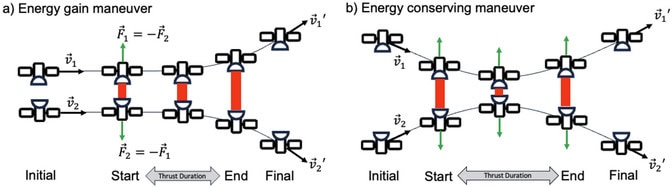
The illustration shows two of the maneuvers that could be enabled by transferring momentum through laser interlinks. In one, two satellites moving in parallel to one another use laser light to change to a divergent trajectory. In another, two satellites that are approaching one another use laser light to effectively bounce off one another without colliding. Credit: Christopher Limbach, Photonic Sensing and Flow Interaction Laboratory, University of Michigan
Satellite constellations have transformed our ability to communicate across the globe while also advancing navigation and Earth observation, needed for applications like weather forecasting, wildfire tracking and disaster recovery. They operate as teams to gather and relay information, but each carries its own fuel and propulsion system to stay positioned correctly, in the right orbit and facing the right direction.
Sharing momentum with laser light could enable satellites to move without the burden and limitations of onboard fuel, while sharing energy can be used to enhance the efficiency of existing propulsion systems. Integrating these new operating modes with existing data transfer technology is the aim of the three-year project, called Orbital Architectures for Cooperative Laser Energetics, or ORACLE.
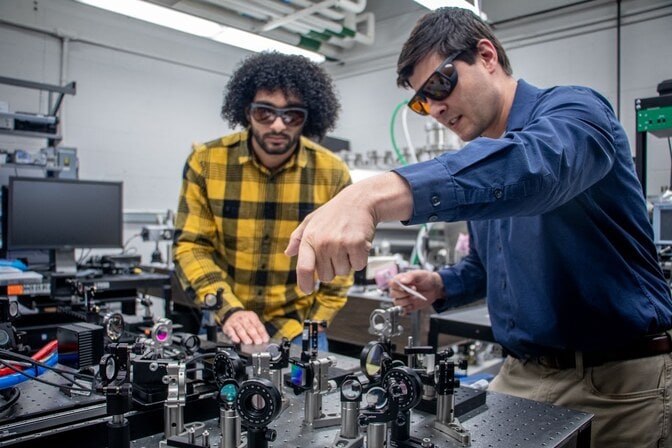
Bilal Hassan (left), a PhD student in aerospace engineering, discusses how to configure a pulse shaper with Limbach (right). With funding from the Air Force Office of Scientific Research, Limbach is leading a team that aims to enable satellites to share energy and momentum through laser interlinks. Credit: Jason Bolton, Aerospace Engineering, University of Michigan
“With the explosive growth of satellite constellations, we are now at a moment where expanding cooperation between satellites via laser links can create capabilities we’ve never seen before. By integrating data, power and momentum sharing into a single laser-based framework, ORACLE could transform constellations from collections of independent satellites into dynamic, interconnected systems,” said Christopher Limbach, U-M assistant professor of aerospace engineering, who leads the new project.
These new capabilities will improve the sustainability and lifetimes of space missions and make them more resilient to disruptions such as space weather. They will also make satellite constellations easier to reconfigure and facilitate the repositioning or removal of space debris.
The team is attacking the problem on four fronts:
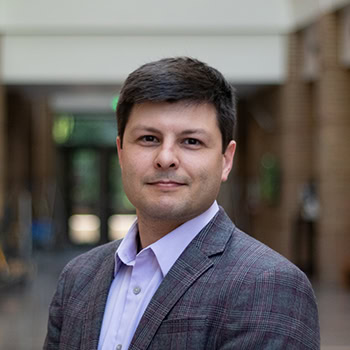
Next-generation materials that allow satellites to efficiently convert laser beams into usable power while also serving as communication channels or solar power converters. This area is led by Seth Hubbard, an expert in designing and fabricating advanced photovoltaic materials and head of physics and astronomy at the Rochester Institute of Technology.
Techniques that enable multiple laser beam bounces between satellites, amplifying the thrust provided by light for propellant-free maneuvering. This research thrust is led by Limbach, who brings expertise in how lasers may be used for space propulsion and power.
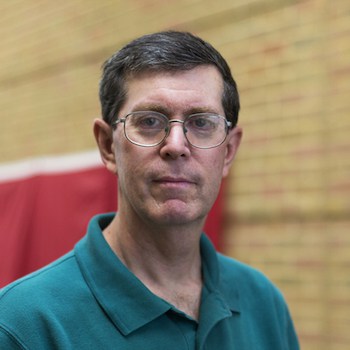
Advanced control and stabilization algorithms to maintain precise laser links despite unpredictable space environments. Dennis Bernstein, a leader in control theory and vibration suppression and the James E. Knott professor of aerospace engineering at U-M, heads this effort.
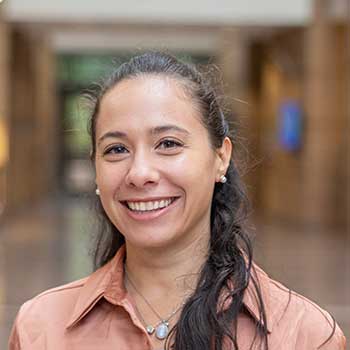
Constellation-level decision frameworks that allow thousands of satellites to cooperate, redistribute resources and execute maneuvers on an unprecedented scale. This effort is led by Giusy Falcone, U-M expert in astrodynamics and autonomous decision-making and assistant professor of aerospace engineering.
In the final year of the project, the team members will integrate their technologies to create the first demonstration of a laser terminal capable of data, power and momentum transfer.
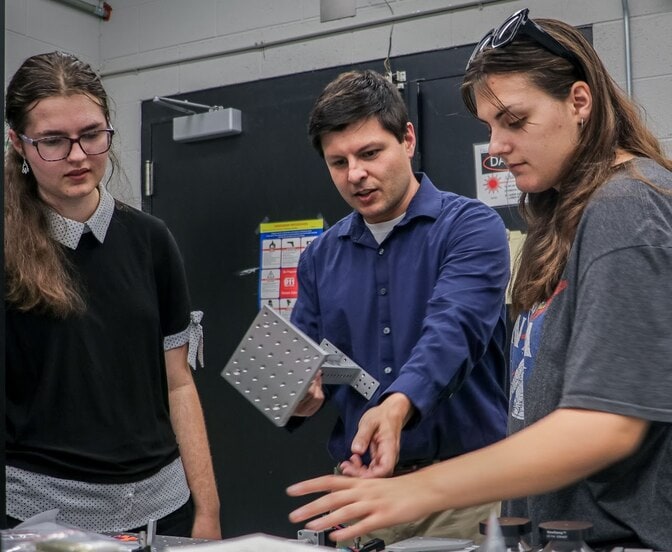
Reganne Watts (left), and Ashley Carman (right), undergraduate students in aerospace engineering, discuss the setup for a sensitive nanoNewton thrust stand with Limbach (center). With funding from the Air Force Office of Scientific Research, Limbach is leading a team that aims to enable satellites to share energy and momentum through laser interlinks. Credit: Jason Bolton, Aerospace Engineering, University of Michigan
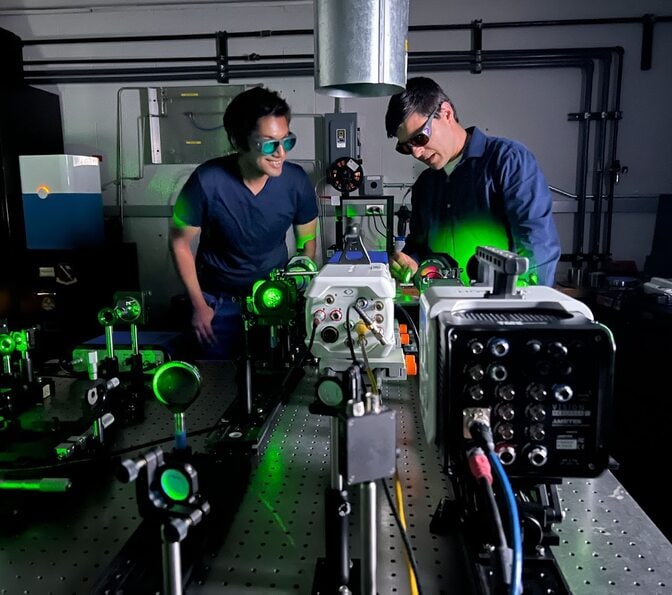
Rishav Choudhary (left), a postdoctoral student in aerospace engineering, looks at a tomographic interferometry optical system with Limbach (right). With funding from the Air Force Office of Scientific Research, Limbach is leading a team that aims to enable satellites to share energy and momentum through laser interlinks. Credit: Jason Bolton, Aerospace Engineering, University of Michigan
The rising researchers will lead projects including smart bandages for monitoring wounds, improved air traffic management and real-time tumor tracking.
With more than 60 environments, the simulated proving ground aims to speed the development of AI controllers that optimize drag, lift, noise and heat management.