New energy for fusion power
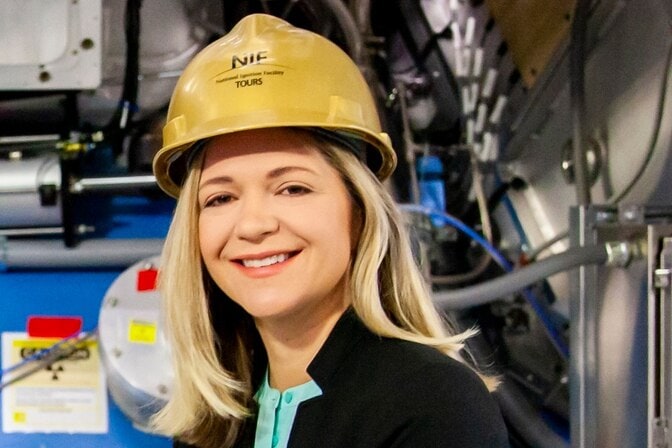
Annie Kritcher (BS NERS ‘05) launched a new era in fusion energy research.

Annie Kritcher (BS NERS ‘05) launched a new era in fusion energy research.
Andrea (Annie) Kritcher (BSE NERS ’05) led and designed the 2022 National Ignition Facility (NIF) experiment that achieved the world’s first fusion ignition—a milestone in which the energy emitted by a fusion reaction “shot” is more than the energy used to compress the fuel.
Kritcher’s accomplishment was hailed by U.S. Department of Energy Secretary Jennifer Granholm as “one of the most impressive scientific feats of the 21st century.” It also landed Kritcher on TIME magazine’s list of the 100 most influential people of 2023.
Kritcher’s main role is helping the NIF pursue its primary mission of maintaining the reliability, security and safety of the United States’ nuclear weapons stockpile. But she also continues to drive essential research into fusion energy, which for decades has been chasing the dream of harnessing the same phenomenon that powers the stars to provide humans with abundant, carbon-free energy.
Fusion is, in essence, the opposite of the fission that powers today’s nuclear power plants. Instead of splitting heavy atoms, it fuses two light atoms into a single atom that’s lighter than the sum of its predecessors, turning the extra mass into huge amounts of energy. There’s no long-lived radioactive waste, and unlike fission, there’s no risk of a meltdown.
Kritcher said she considered a variety of engineering paths in her early days at U-M, but was ultimately drawn to the top-ranked nuclear engineering department in the nation, as well as fusion, one of science’s toughest challenges.
“I was really looking for that big problem that was so hard that it could keep me busy for a long time,” she said. “And fusion also has this very high-risk, high-reward aspect to it. It’s big science.”
Fusion energy has seen a flurry of activity in recent years, both at public labs and private startups. But the NIF is the only place in the United States where researchers can watch it happen.
“There are a lot of different approaches on the table right now,” Kritcher said. “The startups are studying those technologies, but only we can directly study the physics of igniting fusion.”
Since her 2022 breakthrough, she has become something of a celebrity in the physics community. Speaking to high-level physics colloquia, grade school classes and everything in between, Kritcher has used her new stature to advocate for fusion research and encourage more students to join STEM fields.
“Getting the public to adopt this is key to making fusion work in the long term,” she said. “So getting younger people engaged as advocates as well as scientists is so important. The field is small and we really need to grow all aspects of it.
“Fusion is the next big thing that humanity needs to do.It has massive power and potential, and I want to get other people as excited as I am.”