U-Michigan ‘Battery Lab 2.0’ expansion open for innovation
Open to industry and academic researchers, the lab will help move more battery technology to market.

Open to industry and academic researchers, the lab will help move more battery technology to market.
Experts

Director of the U-M Electric Vehicle Center
Professor of Materials Science and Engineering and Mechanical Engineering.
In a step designed to maintain U.S. research and development momentum in next-generation battery technology for electric vehicles (EVs) and beyond, the University of Michigan has expanded its open-access U-M Battery Lab with a second off-campus facility.
On-screen text: A new 8,000 square foot battery lab is now open at the University of Michigan! The state-of-art facility is a resource for companies without their own manufacturing capabilities. The space specializes in assembling pouch and cylindrical battery cells, the common industry format. These lithium-ion, solid-state and next-gen rechargeable batteries are used in energy storage, electronics, drones, defense, and EVs. It’s an expansion of U-M’s existing battery lab, open since 2014 and always in demand. These facilities help companies accelerate battery innovation and bring prototypes to market.
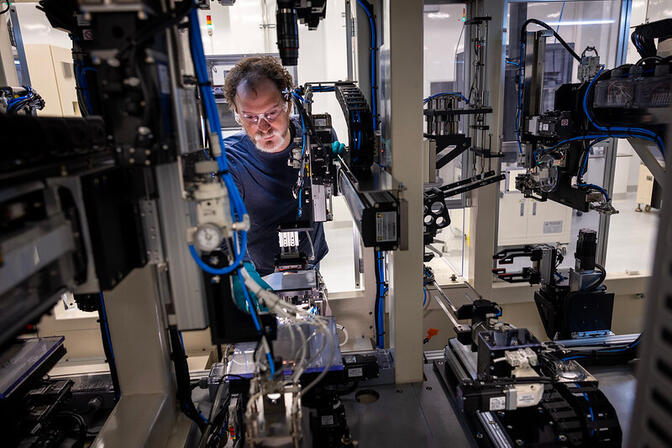
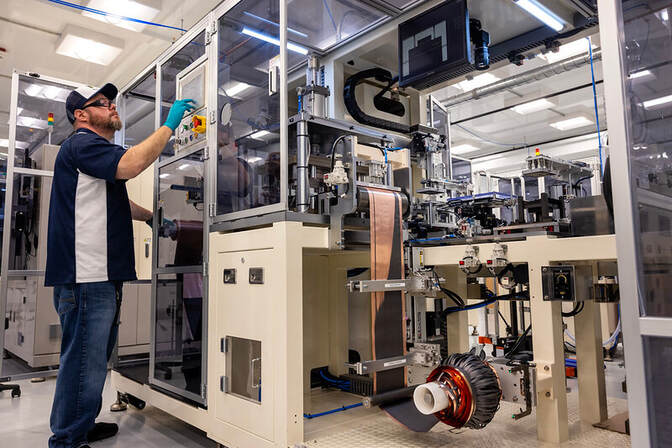
Open to both academic and industry researchers, Battery Lab 2.0 adds 4,000 square feet of lab and production space on Ellsworth Road in Ann Arbor. Its machinery lineup includes an industry-standard automatic laser welder for assembling battery modules and packs. And its three-megawatt-hour lithium-ion battery production line is believed to be the highest-capacity pilot-scale line based at a university.
“In the decade since the original U-M Battery Lab opened—the first of its kind in the country and now the only one in the heart of the auto industry—it’s been a critical enabler. It’s helped to catalyze many of the battery advancements now powering today’s EVs,” said Alan Taub, director of the U-M Electric Vehicle Center and professor of materials science and engineering and mechanical engineering.
“But demand has consistently outpaced capacity, which is why we’ve expanded—giving researchers even more room to build the future.”
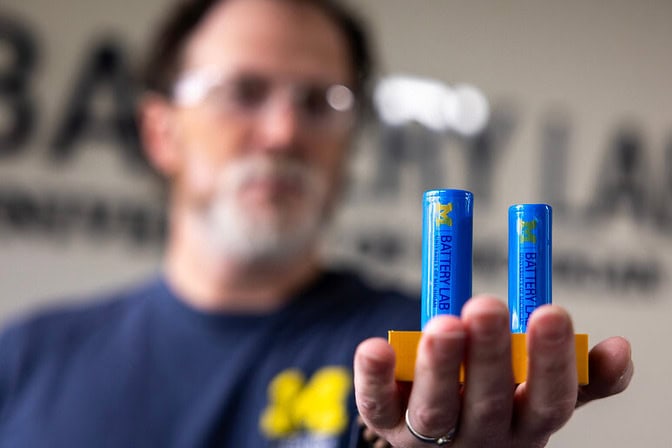
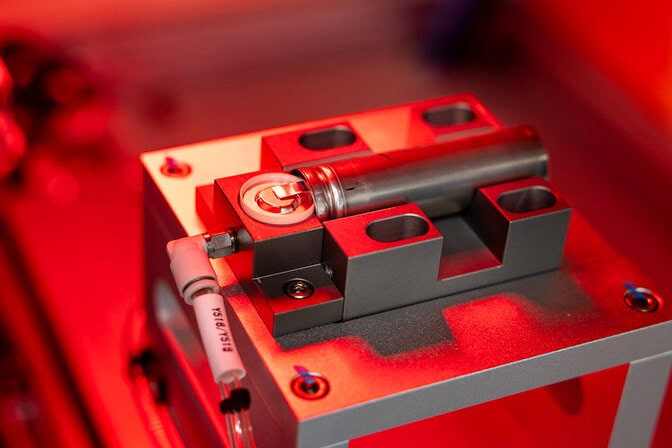
The lab’s capabilities include prototyping, testing and manufacturing multiple lithium-ion, solid-state and next-generation rechargeable batteries in both pouch and cylindrical formats. These common formats have applications in grid storage, personal electronics, backup generators, drones and defense technologies, for example, as well as EVs.

Michigan Engineering is reinventing U.S. manufacturing for resilience and scale
Makerspaces like U-M’s Battery Lab provide opportunities for companies without in-house labs or manufacturing facilities to test ideas, tailor prototypes and make products. Lab users have included established companies like Ford, Mercedes-Benz, and PPG Industries, as well as startups like MIT-spinout Nanoramic.
Crain’s Detroit Business
U-M expands off-campus battery lab as it gears up for $60M project
“We bridge the ‘valley of death’—the period between a promising concept or early-stage technology and commercial production. We provide the infrastructure, equipment and expertise to prove you have a product,” said Greg Less, battery lab director.
“We’ve supported major automakers, and we also give smaller operations a seat at the table. The more new ideas that see the light of day, the faster technology advances. And what we offer them is as close to industrial prototyping as you can get.”
Nanoramic describes the lab as “pivotal in advancing their R&D efforts.” Late last year, the company raised $44 million in a round of financing co-led by GM Ventures and with Samsung Ventures participating.
The original Battery Lab opened on U-M’s North Campus in 2014. Almost immediately, and ever since, the $9 million facility has been fully booked by academic and industrial researchers from around the globe. Its location makes it accessible to a variety of industries.
“Being near the automotive industry is a symbiotic benefit,” Less said. “They don’t have to increase their internal capability because they can take advantage of what we have. And when they come to campus, we learn from them.”
The lab expansion, located on Ellsworth Road, includes:
Battery Lab 2.0 is a stopgap during design and construction of a $60 million on-campus battery lab that will be an addition to the U-M Transportation Research Institute building. Funding for this expansion as well as the future on-campus lab comes from the state of Michigan $130 million contract that established the Electric Vehicle Center in 2023.
Battery Lab 2.0 is located off U-M’s campus, near Ann Arbor’s southern border which allows industrial users easier access. The new equipment was manufactured by Energy Tech Solution.