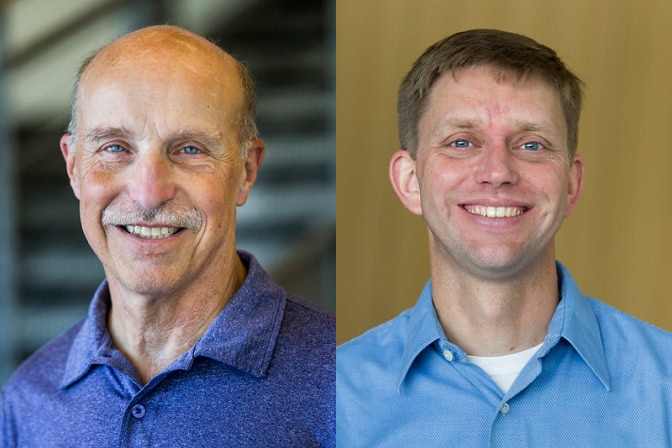
Solving for ‘what if’: A Q&A on risk with Jim Bagian and Seth Guikema
Co-founders of the Center for Risk Analysis Informed Decision Engineering discuss its history and the increasing need for its expertise.

Co-founders of the Center for Risk Analysis Informed Decision Engineering discuss its history and the increasing need for its expertise.
Experts
Professor of Industrial and Operations Engineering
Research Professor of Anesthesiology
Professor of Civil and Environmental Engineering
Professor of Industrial and Operations Engineering
“Risk,” as Jim Bagian likes to say, “is a part of everything we do.” But different fields and communities have vastly different perceptions and tolerances of it—gaps that can unwittingly lead to system failures and tragedies. Bagian helped start the University of Michigan’s Center for Risk Analysis Informed Decision Engineering (RAIDE) in early 2020 because he recognized the disconnects and envisioned a better way.
He and co-founder Seth Guikema, a U-M professor of civil and environmental engineering, as well as industrial and operations engineering, believe that the identification of hazards and their associated risks needs to be factored into engineering decisions systematically and through interdisciplinary lenses. They launched RAIDE to develop real-world ready, risk-informed decision-making models for engineers that incorporate engineering, behavioral science, public policy, communication and systems engineering.

Michigan Engineering is on the vanguard of the next infrastructure revolution
Importantly, their models are designed to work in the face of uncertainty, which plagues many of today’s pressing challenges. It’s an approach that has proven valuable in a variety of applications, and has particular significance in considering what level of resilience and reliability is appropriate for infrastructure elements such as roads, bridges, power grids, and water systems as well as in autonomous vehicles.
Communities, governments and industry are all confronted with how best to prepare for the future. In this interview, Bagian and Guikema discuss the wide universe of considerations that need to go into major engineering projects, as well as the pitfalls and opportunities that come with them.
Bagian is a U-M professor of industrial and operations engineering, and a research professor of anesthesiology.
Guikema: Risk is often a calculation that only comes in at the end of the design process. It needs to be a tool that’s implemented from the start so that risk, reliability and resilience considerations can impact the basic design choices. Also, too often people focus on the reliability aspect instead of the risk component. They’re just looking at the possibility of an initial failure scenario—not thinking about how to develop a system that ages gracefully and recovers well.
Guikema: There are two ways in general. Look at infrastructure. Being on top of risk issues like, say, road or bridge conditions, can pay off by not interrupting traffic flow or supply chains, etc. It can also save consumers millions of dollars on car maintenance.
You’re also talking about a wider economic impact. You want better, more informed options for building infrastructure that can deal with any kinds of disruptions that come along. That allows us to get people back to their normal productive lives.
Also, evaluating risk to establish and maintain crucial systems creates economic opportunity. If we can create reliable high capacity infrastructure, particularly in power and water, this can then make an area more attractive for manufacturing, or, say, water-intensive ventures like data centers.
Bagian: You have to start with the ultimate desired goal. The goal serves as the North Star and sets a point of reference for describing the risk of not achieving the goal. From there, you begin to identify what the hazards and their associated risks are, but you have to go beyond physical threats to the built environment. They can touch on myriad factors such as social, ethical, economic, legal and even public opinion issues. All of those things make a difference. Once you know what those hazards and associated risks are, it becomes a question of what are the opportunity costs if you choose to accept those risks or mitigate them, or how much do you mitigate them?
Consider power supply. The goal for a power company, when you get down to it, isn’t that their power generation doesn’t fail. It’s that when a consumer flips the light switch, the power comes on as the user expects it to do. You want the power generation to be reliable, so the questions begin from there. What could go wrong? Will the power lines stay up, or are trees likely to fall on them? Will the system be overloaded because you’re too dependent on solar and don’t have enough other sources to provide power when the available solar isn’t adequate to meet demand.? How much redundancy do you have in the system and what risk level are you willing to deal with?
Nothing is ever 100% certain in these cases, so you need to attempt to take a wide variety of factors and their potential positive and negative impacts into account. You never want something unexpected to hit a project simply because there was a failure of imagination.
Guikema: We began by working on COVID-19 issues at U-M. We did a lot of risk modeling related to how COVID could spread in the classroom. We studied the effectiveness of using temperature screening of individuals as a method of preventing spread. It turned out that it wasn’t really effective. We did identify modifications of the ventilation systems and configuration of lecture and classrooms that could decrease the likelihood of COVID infection and spread.
We’ve analyzed risks involved with autonomous vehicles and hosted a workshop related to that. But infrastructure and resilience has become a focal point in recent years. We see resilience as an essential consideration in the reliability of a system.
When you’re rebuilding after situations such as Hurricane Sandy or Hurricane Katrina, you don’t want to just build back to where you were. In many cases, that would only put you right back to being behind the curve of the latest infrastructure designs technologies.
What you want to do is use these opportunities to bounce forward… to end up with a system that’s better off than what you started with, not worse off. So you ask what is the response and restoration process? And what is the long-term adaptation plan for improving the state of the infrastructure?
Guikema: There aren’t many of these risk centers in the U.S. and what separates RAIDE further is our approach.
Bagian: It’s a system-wide view to look at any endeavor, infrastructure related or not, to help it be successful in achieving it in the most consistent and reliable manner possible. This is a proactive and not a reactive approach. Unfortunately, all too often change to improve performance seems to come about only after suffering an adverse outcome that was potentially preventable had risk-based planning been involved from the outset. Experience is often said to be the best teacher but it is often a very expensive way to learn. Our approach is focused on identifying the existing hazards and risks so as to inform leadership and enable them to make better decisions and minimize the chance of an undesired outcome.
And that means taking into account a wide variety of factors. For example, look at communication, which is something critical that’s not always thought about in engineering schools. You can’t be effective at dealing with risk and resilience if you don’t think about communication—particularly around hazards. It’s the communication that results in the identification of hazards and their impact on the achievement of the desired goals that then informs the decision makers so that they appropriately balance the needs, risks, and opportunity costs to best meet the needs of the universe of stakeholders.
Good communication allows you to manage expectations so those audiences understand and are prepared when you come to them with something like a rate increase.
Guikema: But in addition to that systems view, in the infrastructure area, Michigan Engineering has incredible, hands-on engineering research and facilities where we can test solutions. Michigan Engineering has a Pavement Research Center of Excellence, a Structural Durability Lab and, on the funding side, we have the Center for Digital Asset Finance. Those are just a few of many engineering research centers.
We even have expertise in weather forecasting through our Department of Climate and Space Sciences and Engineering.
There aren’t many places that combine both aspects. We’re good at systems-level analysis and we have detailed engineering expertise.