BepiColombo spacecraft enters Mercury’s orbit, becoming second ever
To help uncover the planet’s origin story, University of Michigan Engineering will lead operations of one of BepiColombo’s instruments.

To help uncover the planet’s origin story, University of Michigan Engineering will lead operations of one of BepiColombo’s instruments.
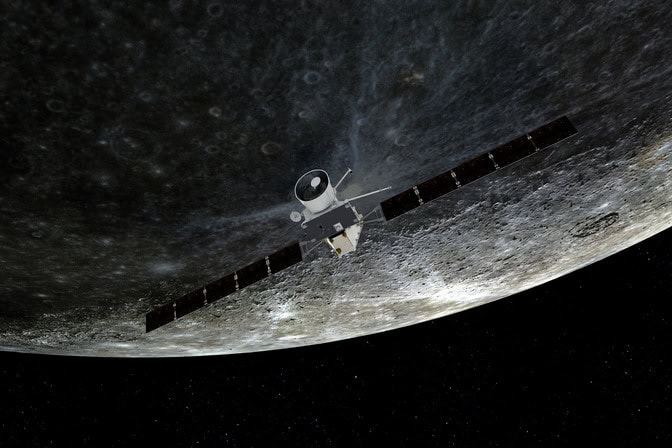
After an eight-year journey through the solar system, the BepiColombo—a joint mission by the European Space Agency (ESA) and the Japan Aerospace Exploration Agency (JAXA)—has finally arrived at Mercury. It’s now the second spacecraft, and the first two-probe system, to ever orbit the planet closest to the sun.
The mission hopes to answer fundamental questions about one of the solar system’s least studied planets: Where did Mercury come from? Why is its metallic core so large? And why does it have a magnetic field, when the planet seems too small to have one?
Researchers from University of Michigan Engineering will help solve these Hermean mysteries by operating NASA’s Strofio instrument, part of the Italian-led SERENA, one of 11 instruments aboard the ESA half of BepiColombo. Strofio will determine what Mercury’s ultra-thin atmosphere is made of, which the researchers hope will provide clues about the planet’s story.
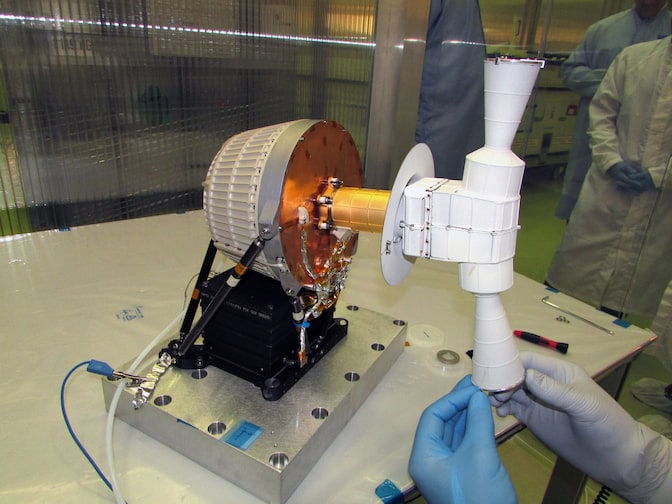
“This gas is coming from the planet’s surface, so it brings an imprint of what the surface itself is made of, and how it’s changing,” said Stefano Livi, a research professor of climate and space sciences and engineering and the principal investigator of the Strofio instrument.
“Strofio will identify the uncharged molecules and elements in the sparse atmosphere to help find out how the atmosphere behaves, where it comes from and how that affects the surface of the planet,” Livi said. “Chemistry; it’s beautiful. It gives you a lot of information.”
Scientists once thought that because Mercury was so small, its core should have solidified since the planet’s early years as a condensing ball of gas. And without the dynamo effect of a liquid metal core, it definitely couldn’t have a magnetic field.
That view was upended by NASA’s Mariner 10 mission, the first spacecraft to visit Mercury. As the spacecraft flew by the planet between 1974 and 1975, its instruments detected a weak magnetic field likely generated by an iron core with a molten outer layer. The discovery meant Mercury was the only other rocky planet in the solar system other than Earth with a global magnetic field.
So why hasn’t Mercury cooled down? Some scientists think that Mercury’s core has enough sulfur to drop the freezing point of iron, creating a fluid layer that could generate a magnetic field. Mercury is also stretched and squeezed by the sun as it moves along its oblong orbit, similar to how the moon creates tides on Earth. The tidal forces could also heat Mercury’s core, and BepiColombo’s measurements will help scientists sort out which explanations are most plausible.
“If we find sulfur or sulfur-bearing molecules in the atmosphere, it could mean there is a lot of extra sulfur on the surface of the planet,” said Livi. “That would imply that there might be a lot of sulfur down deep.”
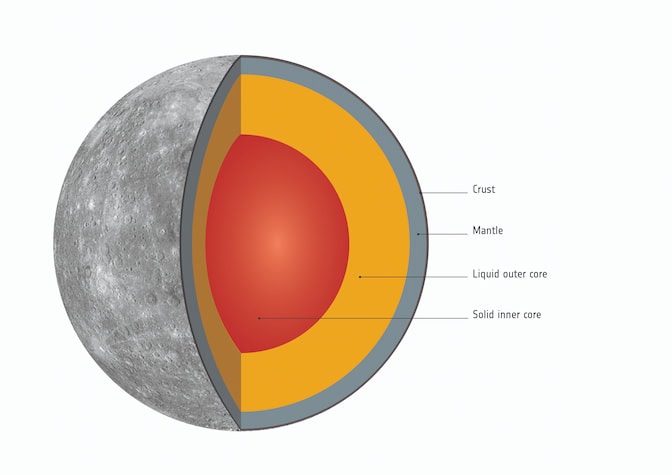
Mariner 10 discovered another surprise about Mercury’s core. It takes up a large proportion of the planet, accounting for 85% of its radius and half of its mass. Earth’s core, in comparison, makes up only a third of its mass. The massive core gives Mercury a much higher iron to rock ratio than the other rocky planets, leading some scientists to suspect Mercury once had more rock in its outer layers.
But how did Mercury lose so much rock? One explanation is that Mercury’s outer layers of rock evaporated in the early days of the solar system. The elevated temperatures and the constant stream of charged particles flowing from the sun, called the solar wind, would have vaporized much of Mercury layer by layer.
But then NASA’s MESSENGER spacecraft started orbiting Mercury in 2011—becoming the first spacecraft to ever do so. MESSENGER found a high amount of volatile elements such as potassium on Mercury’s surface relative to less volatile elements like thorium. Its Fast Imaging Plasma Spectrometer (FIPS) instrument—designed and built at Michigan Engineering—also detected volatile elements in Mercury’s atmosphere. But if the planet had been in its current location throughout its entire history, most of its volatile elements would have weathered away by now.
The finding of elevated volatile elements on Mercury led some scientists to suggest that Mercury actually formed further away from the Sun. If this theory is true, Mercury would have been knocked into its current location in the solar system after being hit by another celestial object. The crash would have ejected tons of material into space and could explain why Mercury has an oversized core.
But the impact theory has its own problems. Volatile elements would have been vaporized in that impact too. If Mercury’s rock gradually evaporated, more heavy elements would have been left behind relative to lighter elements, since denser materials are more common in the cores of planets. But during an impact, the planet’s layers would have mixed, and the ratio of heavy to light elements would be smaller.
“Determining the chemical composition of Mercury’s atmosphere will give important clues on which of the proposed mechanisms is more viable,” Livi said.
And Strofio brings new capabilities to finding those signatures. It can directly collect and identify entire molecules, whereas instruments on MESSENGER and Mariner 10 could only identify some elements. And because Strofio is also more sensitive than the instruments MESSENGER’s used to directly sample the atmosphere, it can tell more kinds of elements apart.
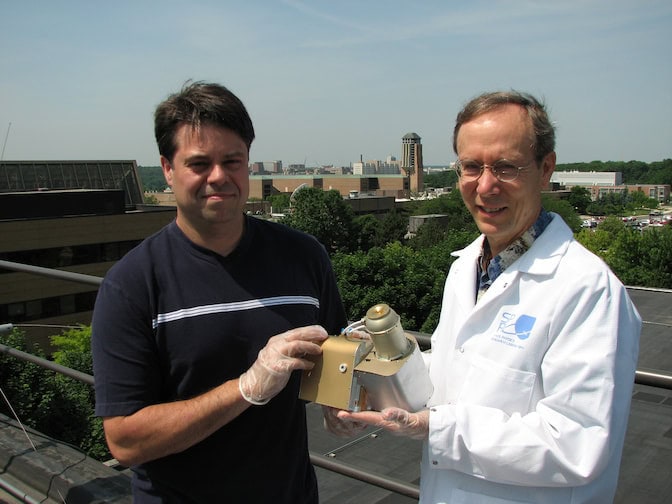
“Imagine if you were driving through a city in the dark, and you couldn’t really tell different things apart. That was the situation while measuring the atmosphere in the past missions,” said Jim Raines, an associate professor of climate and space sciences and engineering involved in day-to-day operation of Strofio. He was also a scientist and engineer for MESSENGER’s FIPS instrument. “We’re really taking a couple steps up with BepiColombo. With two spacecraft and many more instruments, it will be like driving in the day compared to MESSENGER.”
Solving the puzzle around Mercury’s core and magnetic field is about more than just understanding another world. It could also provide a new perspective on Earth.
Modern society relies heavily on Earth’s magnetic field for both navigation and to protect satellite technology from the most hazardous solar and cosmic radiation. But Earth’s magnetic field isn’t constant or guaranteed. Earth’s magnetic field has been weakening on average over the past 200 years, and Mars had a global magnetic field that disappeared. Understanding why Mercury still has its magnetic field could help predict how Earth’s magnetic field will change over time.
BepiColombo’s two-probe system could also help scientists learn how atoms and their electrically charged variants, called ions, are accelerated to high energy and speeds in Mercury’s incredibly harsh environment, where the solar wind is six to 30 times greater than at Earth.
The probes will orbit together but at different altitudes. The ESA probe, the Mercury Planetary Orbiter (MPO), will be closer to Mercury’s surface, and the JAXA probe, Mio, will be at a higher altitude. Higher energy atoms and ions are more common at higher altitudes, so having a probe at two locations could allow scientists to trace where they are formed and how they move and accelerate.
“We’ll learn the whole lifecycle of these universal processes, and Mercury provides a laboratory for studying them in an environment that’s similar, but slightly different from Earth,” said Raines. “As we increasingly rely on technology in the space environment, we want to understand how magnetic fields interact with the solar wind, and how energy flows through that system. In the future, we may learn enough to use that energy.”