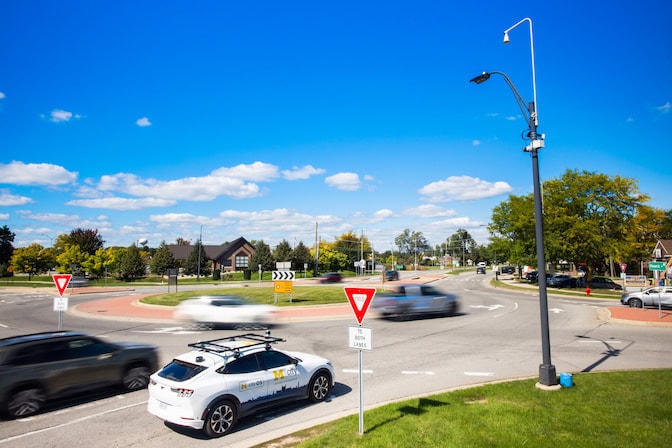
U-M to improve pedestrian, vehicle safety at intersections with $5.66 million from U.S. DOT
New system could provide warnings to pedestrians and drivers to prevent crashes.

New system could provide warnings to pedestrians and drivers to prevent crashes.
RESEARCH TO WATCH
Building on technology that detects vehicles, pedestrians and cyclists on roads and sidewalks, engineers at the University of Michigan Transportation Research Institute (UMTRI) are developing a crash-prevention system with $5.66 million from the U.S. Department of Transportation (U.S. DOT).
The new system is called Safety Actions for Everyone at Traffic Intersections (SAFETI).
“Our goal is to prevent crashes in the moment and to make intersections safer over time,” said Henry Liu, director of UMTRI, professor of civil and environmental engineering and the project’s principal investigator. “SAFETI predicts conflicts and responds through warnings, in-pavement lights or signal changes, and it learns where recurring risks are so agencies can fix them for good.”
U.S. DOT reports that roughly one quarter of traffic fatalities and about one half of all traffic injuries in the U.S. are attributed to intersections. The University of Michigan Engineering team believes that by utilizing technology already in place—traffic signal controls, vehicle-to-everything (V2X) communication, onboard sensing equipment, city traffic cameras, smartphone alerts and in-vehicle dashboards—they could predict and prevent intersection crashes.
“With this award, we’re advancing MSight, our open-source roadside perception framework developed in-house, into a near-miss prediction system,” said Sean Shen, a research engineer at UMTRI. “We hope this work can move beyond the lab and Mcity Test Facility and into real-world, scalable deployment, where it can actually save lives.”
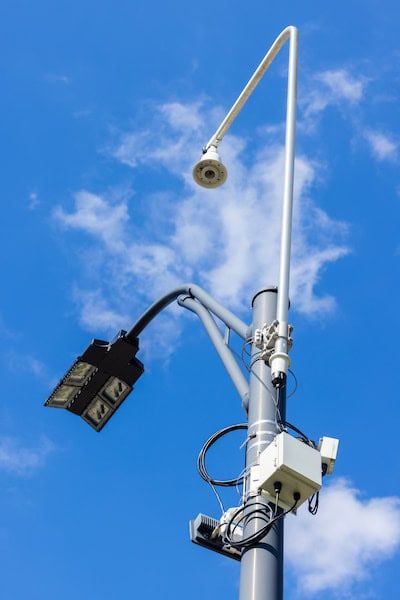
Imagine a pedestrian, one who’s dangerously fixated on their cellphone screen, approaching an intersection. At the same time, a vehicle approaches the intersection, putting the two on a direct collision course.
Cameras posted at the intersection and the vehicle’s LiDAR sensors catch the approaching pedestrian, who is not slowing down as they get closer to the edge of the sidewalk. Almost simultaneously, the driver could receive a dashboard warning or be alerted to the potential collision by lights embedded in the pavement, while the pedestrian might receive a cellphone notification—much like a severe weather alert.
Potential accident avoided.
MSight could also prevent vehicle-vehicle collisions. When a vehicle appears likely to run a red light, the system could alert all approaching drivers. The traffic control system can also respond accordingly in that scenario, extending a green light and keeping cross traffic at a red.
Because the new collision-avoidance technology is part of an open-source project, it will eventually be made available for anyone to use and adapt.
The data that the system collects from sensors and cameras does not allow for individual vehicles to be identified, protecting privacy. For example, in Ann Arbor, traffic cameras use fisheye lenses, meaning they cannot pick up specific license plates or facial details. SAFETI’s algorithm only identifies what the object is—a vehicle, bicycle or pedestrian. With cities that utilize pinhole cameras, the view can be blurred by those accessing the dashboard.
SAFETI will unfold over three-and-a-half years through two phases. For the first phase—roughly 18 months—engineers will work on prototyping the MSight system, using Mcity’s physical and virtual testing environments, along with in-vehicle integration provided by partners General Motors (GM), Volkswagen and Ford.
“A key part of Phase 1 will focus on the human elements of intersection safety,” said Monica Jones, an associate research scientist and group head of UMTRI’s Human Factors Group. “At Mcity, the research team will evaluate not only whether SAFETI can detect and predict conflicts, but also whether drivers and people outside the vehicle can recognize, understand and respond appropriately to the system’s warnings and interventions.”
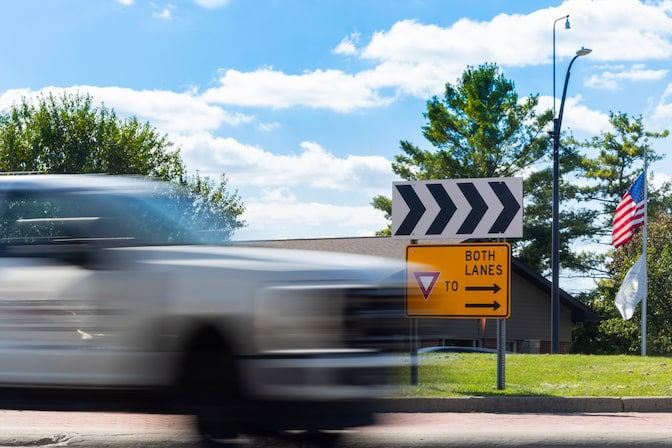
At Mcity, the pedestrians and cyclists will be robots, enabling the research team to study how well the system works for human drivers without putting people in danger.
The second phase will involve the real-world deployment of MSight at four intersections in Ann Arbor. If successful, MSight could eventually be rolled out nationwide.
Along with GM, Volkswagen and Ford, U-M’s private sector partners in developing the SAFETI program include Ouster. Public sector partners include the Michigan Department of Transportation, the City of Ann Arbor and the Southeast Michigan Council of Governments.