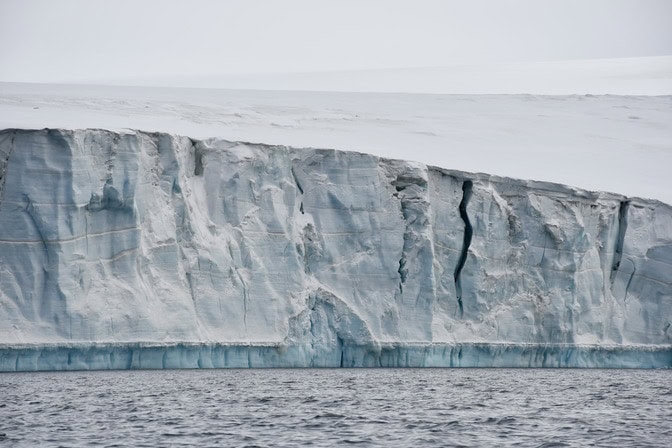
Glacier cliffs break into sea faster than predicted, but restabilize
Over 15,000 aerial and satellite images suggest that glaciers can undergo faster periods of disintegration than previously assumed.

Over 15,000 aerial and satellite images suggest that glaciers can undergo faster periods of disintegration than previously assumed.
More than 15,000 images taken with satellites and from airplanes show that large cliff faces can fall off glaciers faster than some climate models assumed, according to a study by the Woods Hole Oceanographic Institution (WHOI) and University of Michigan Engineering. The results suggest that some estimates of higher and faster sea level rise, which have been dismissed by some scientists, could be more likely than previously thought.
“High-end sea level rise associated with really rapidly breaking cliffs has been somewhat dismissed as being an unlikely scenario, but maybe we shouldn’t rule out some of the higher estimates,” said Jeremy Bassis, a professor of climate and space sciences and engineering at U-M and co-author of the study, published today in Science.
“Fortunately, all of the examples we have so far suggest that the glaciers eventually restabilize, so the projections of sea level rise that rely on a runaway, total disintegration of the ice sheet aren’t supported,” said Bassis. “But we may see higher rates of sea level rise than some people thought possible due to large breaks in portions of the ice sheets.”
The researchers collected photos of glacier cliffs in Greenland and Antarctica to help settle a debate about how quickly ice cliffs break off glaciers. The debate stems in part from a 2012 study by Bassis and Catherine Walker. At the time, Walker was a doctoral student in Bassis’s lab. Now she holds a faculty position at WHOI and is a co-author of the new study, which was funded in part by NASA, the National Science Foundation and the U.S. Department of Energy.
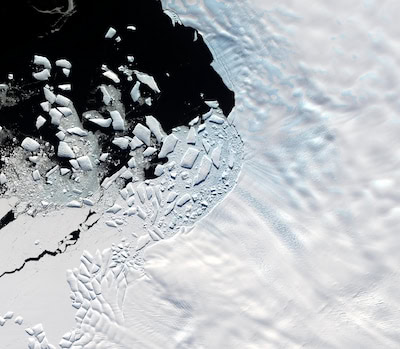
The 2012 study tried to answer a seemingly innocuous question: why were ice cliffs rarely taller than 100 meters above the ocean? They determined that large cliffs eventually become unstable and break apart when they are pushed into deeper waters. The cliffs are pushed into the ocean as snow and ice naturally build up at higher elevations further inland.
“The ice basically can’t support its own weight, and it crumbles,” said Bassis. “That’s why we don’t have skyscrapers that go to the moon. You’re limited by the strength of the materials.”
The 2012 study resulted in a range of possible values for ice cliff stability that other scientists later used in models of glacier melt and sea level rise. Some models that used the team’s values of ice cliff stability suggested a runaway effect. As glaciers melted at the coast, large cliff faces would be inherently unstable and quickly break. When those cliffs broke off the glacier, they would reveal more unstable cliff faces, which themselves would quickly break apart.
Estimates of sea level rise were twice as fast in climate models that used the runaway glacial breakdown compared to models that assumed more stable glaciers. Some glaciers have been called “doomsday glaciers” in the press because of the suggestion that they could rapidly collapse and flood coastal cities.
“But, up to this point, there was no observational evidence that glaciers would disintegrate so rapidly, which sparked debate about what rate of sea level rise was realistic,” said Walker.
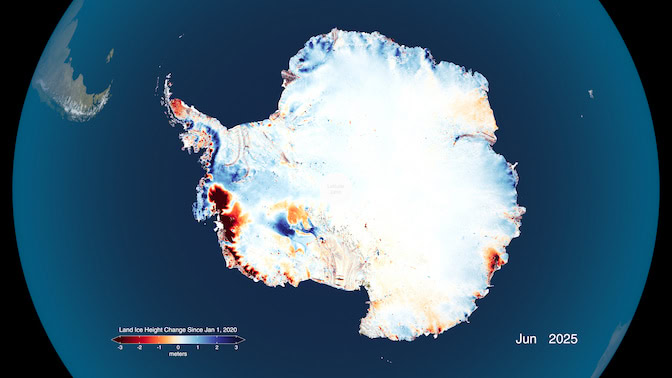
The new collection of data can help identify the most likely scenarios. For example, fast-flowing glaciers with relatively little change in thickness upstream are less likely to have tall, fragile cliff faces after a break, unlike slow-flowing glaciers that get dramatically taller inland. But even fragile cliff faces can sometimes be reinforced by thick layers of frozen seawater and icebergs, called ice mélange.
“We need to be looking at more than just cliff height to more confidently predict whether runaway effects will be a threat in vulnerable places like West Antarctica,” said Caroline Needell, a doctoral student in oceanography in WHOI’s joint program with MIT and the corresponding author of the study.
The research was also funded by the International Thawaites Glacier Collaboration’s DOMINOS project.
Bassis is also a professor of earth and environmental sciences.