Steering wheel communicates for better semi-autonomous driving performance
Unlike driver-assist systems that correct steering without warning, this haptic wheel leads to improved driving, trust and teamwork between the human and automation.

Unlike driver-assist systems that correct steering without warning, this haptic wheel leads to improved driving, trust and teamwork between the human and automation.

Explore the forefront of AI
at Michigan Engineering
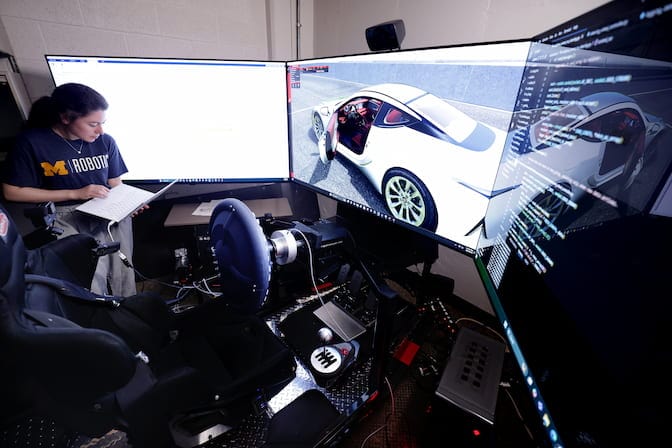
A specialized steering wheel, enabling negotiation between drivers and an autonomous driving simulation, improved driving performance and trust between driver and autonomous vehicle features, researchers from University of Michigan Engineering and the Toyota Research Institute have found.
Typically, drivers of semi-autonomous vehicles receive information through multiple beeps and flashing warning screens, and have to wrestle with the steering wheel when they disagree with the computer’s decision. This often creates confusion, increases stress, and could cause drivers to turn off potentially helpful systems.
>Text on screen: This prototype steering wheel allows drivers to negotiate with their vehicle’s automated features… -by squeezing.
0:12
Assistive and automated features improve safety but some drivers fight or disable them if they don’t like how they behave.
0:22
University of Michigan engineers developed this haptic system to make driving with autonomous systems a team effort.
0:28
It uses areas of inflatable bubbles that can be pushed in as a way to talk back to the vehicle.
0:33
>>Hannah: So this is an indication that the automation wants to turn left.
0:37
If I was to press this bust bubble in disagreement because I want to go right, they will all deflate.
0:44
And if the automation is insisting, for example, that we do go left, it can pulse saying we should go left together.
0:52
There could be danger on the right hand side.
0:55
This allows for preemptive communication with the autonomous vehicle, so there’s no steering fighting along the road.
1:04
>>Text on screen: In a simulation, test drivers experienced a smoother driving experience and less braking using this type of wheel.
1:26
These results suggest collaborative automated driving features can boost driver confidence in automation and improve overall safety.
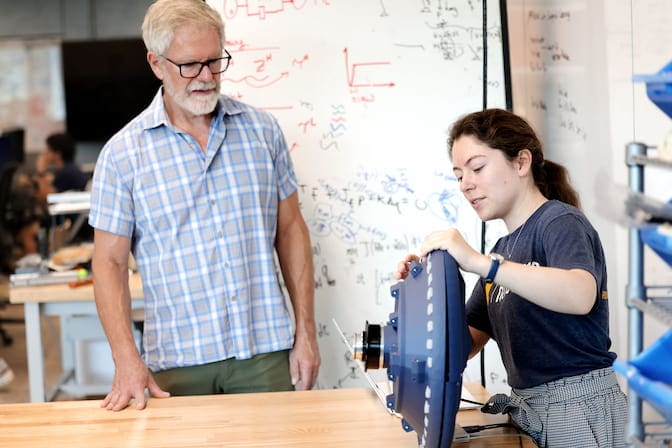
“To improve driver communication with automation, we added two haptic zones onto a steering wheel at 10 o’clock and 2 o’clock that can expand or contract to express the intention of the automated system,” said Hannah Báez, a robotics Ph.D. student and first author of the study in Human Factors.
“Drivers could agree or disagree with the automated system by squeezing the haptic zones, which allowed them to negotiate with the system before a given action to resolve any conflict.”
The Toyota Research Institute funded the work.
The research team put drivers into a simulation where they navigated an upcoming turn. The driver and automation might agree or disagree on the turn direction, and the simulation could also add sudden obstacles in either situation.
As the driver approached the turn, the semi-autonomous system inflated the left or right haptic portion of the steering wheel to indicate the direction it planned on turning. If the driver did not agree, they could squeeze that part of the wheel to indicate disagreement and negotiate the new turn direction. If an obstacle appeared in the driver’s planned path, the steering wheel would also pulse on the side of the obstacle to alert the driver.
Compared with no information or one-way displays of intention, the two-way system showed a clear improvement.
“We found that drivers drove better when negotiating with the automated system through haptic feedback,” said Brent Gillespie, U-M professor of robotics and senior author of the study. “Drivers displayed smoother, more accurate driving paths, fought less with automation and used less braking with more confidence in their maneuvers.”
The negotiation interface also reduced driver workload, with participants reporting significantly lower effort, frustration and physical demand.
Another important finding: after the automated driving system made a mistake, such as missed obstacles or false warnings, the negotiation interface recovered a driver’s trust in the system much faster than those using traditional one-way communication. The researchers believe this is because the driver and system act more as a team with better communication, transparency in decisions and adjusting to feedback, instead of each separately taking turns behind the wheel.
While the negotiation system improved trust recovery, the team noted that some drivers became overly trusting after successful negotiations, highlighting the need for further study of trust with such a system.
While one-way information is the current norm for communication with autonomous vehicles, this research demonstrates the potential benefits of allowing driver and automation to fully communicate intent, agreement and action in a two-way dialogue.
Additional authors of the study include Haochi Pan and Nadine Sarter of the University of Michigan and Jean Costa and John Gideon of the Toyota Research Institute.
The technology is covered by U.S. patent US12227190B2, applied for with the assistance of U-M Innovation Partnerships, and the team is seeking partners to bring the technology to market.
Written by Dan Newman, U-M Robotics