Co-design with the community? Study provides insights on building trust
How and when community stakeholders are engaged shapes participants’ perceived value, learning and progress according to an assessment of a co-design workshop series.

How and when community stakeholders are engaged shapes participants’ perceived value, learning and progress according to an assessment of a co-design workshop series.
Co-design projects give stakeholders a seat at the table, including them as members of the design team, but few studies have evaluated whether they feel heard. A participant-satisfaction study found that how and when people are engaged, as well as who holds decision-making power, shapes meaningful participation.
The study assessed co-design workshops that aimed to improve family planning counseling and follow-up at public health facilities in Addis Ababa, Ethiopia and Nairobi, Kenya. It was led by researchers at University of Michigan Engineering, with collaborators from Derz Consulting in Ethiopia and Kenya.
The results offer tools for practitioners to monitor participants’ satisfaction and use that feedback to create more meaningful and equitable engagement in future global health projects.
“If we’re asking people to share their time, energy and personal experiences with us in a co-design process, we have a responsibility to understand what that process is actually like on their end. Co-design should be valuable for all those involved, and not just useful for the research team,” said Julia Kramer, an assistant professor of mechanical engineering at U-M and corresponding author of the study.
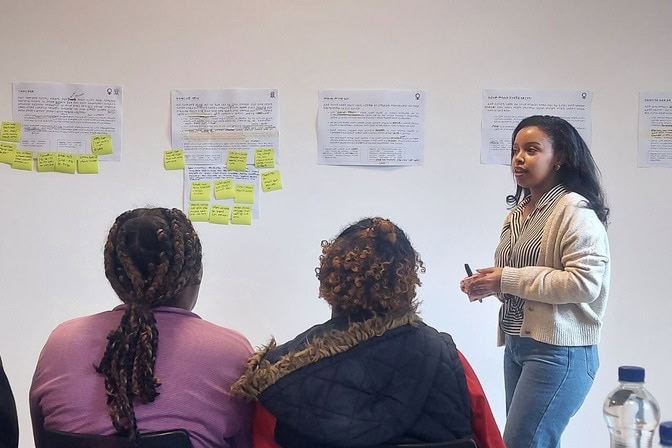
During structured co-design workshops, contraceptive users, married men and family planning providers worked alongside the researchers to create supportive counseling interventions to help women plan if, when and how many children to have. One team in Ethiopia and another in Kenya met for seven separate workshops facilitated in the local language over a year-long period.
To evaluate co-design participant satisfaction, the research team developed surveys based on prior research and supplemented these with observations and in-depth interviews. The evaluation focused on three dimensions of engagement satisfaction: whether they felt valued, what they learned and whether they felt they contributed to the project progress.
“I’ve been really encouraged by how honest our findings were. Both community member co-designers and facilitators were clear about what worked and what didn’t. That kind of honest reflection is exactly what we need to understand how we can improve our engagements and make them more equitable,” said Lauren Wojciechowski, a doctoral student of design science at U-M and lead author of the study.
While the surveys were developed for the family planning project, the research team believes they could be adapted to other co-design efforts, as these three dimensions could apply to other social programs, major construction projects and more.
Participants generally reported positive experiences with co-design. Findings showed participants felt valued, gained new knowledge on both family planning and human-centered design, and felt they contributed to the project.
Value, learning and progress were interconnected. Feeling valued supported participants’ learning. Learning helped participants contribute to project progress. Seeing the project move forward reinforced participants’ sense of feeling valued.
Breaks and casual conversations during workshops helped build trusting relationships amongst co-designers. That trust helped participants feel more comfortable sharing their perspectives while navigating conflicts and learning from one another.
Participants voiced frustration over long gaps between workshops with no contact from the design team. During this timeframe, researchers balanced feedback and ideas generated by workshop participants with input from the local ministries of health as well as the Bill and Melinda Gates Foundation, which funded the project. This frustration highlights the importance of keeping participants updated about progress happening behind the scenes.
“One of the things this process has taught me is that co-design exists within the broader context of project dynamics. It’s not enough to create a co-design space within a workshop. We need to think about how those principles are built into the project itself, and how the outputs are taken forward by the wider team and other decision-makers,” said Emnet Woubishet Teklu, Founding and Managing Partner at Derz Consulting and co-author of the study.
Some of the tension stemmed from outcomes: when participants’ ideas for new family planning interventions were dropped, they felt excluded from decision-making. This conflict reflects the power asymmetries between co-designers and the research team. While participants could meaningfully contribute ideas during workshops, project constraints such as time, money and the realities of implementation limited their influence.
“Going forward, we hope to further investigate how design facilitators support equitable engagement, and how the tensions between participatory ideals and project constraints can be balanced when integrating co-design into global health projects,” said Kramer.
For instance, co-design leaders may communicate the project scope, trade-offs and constraints from an early stage, helping to manage the expectations of community participants.
This research was supported through Gates Foundation grant no. INV-044992.