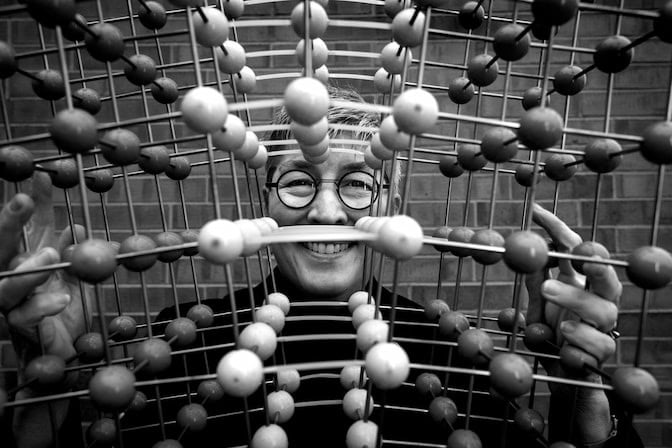
Pioneering computational materials engineering
NAE profile: Elizabeth A. Holm, materials science and engineering.

NAE profile: Elizabeth A. Holm, materials science and engineering.
Get to know Michigan Engineering’s National Academy of Engineering members.
Elizabeth A. Holm developed computer simulations and machine-learning models for understanding and predicting how microstructures—microscopic cracks, pores and crystals— form and change a material’s properties and behavior. Her models gave engineers computational tools to explore and validate materials for long-term use, offering a more efficient, effective alternative to accelerated physical testing. Additionally, they enable engineers to optimize beneficial microstructures and minimize harmful defects. Her tools provided the first computationally generated information to approve a material for widespread use, a new solder alloy to replace lead in circuit boards. For achievements in the development and application of computational methods for understanding microstructural evolution and integrated computational materials engineering, Holm was elected to the National Academy of Engineering in 2025. View the NAE citation.
About Elizabeth A. Holm
After lead was banned and restricted in electronics in the 1990s and early 2000s, Holm led a team at Sandia National Laboratories that used computer models to qualify a lead-free solder material for circuit boards. Holm’s team integrated simulations and experiments to show that tin-silver-copper (abbreviated SAC based on the elements’ symbols) solders would reliably perform over a 50-year timespan. Her analysis was critical for quickly approving materials that lacked performance and aging data because, at the time, they had been widely used for less than a decade. SAC solders are now one of the primary materials used to mount electronics to printed circuit boards.
Holms’ computer-vision models are used in the metal industry to automatically, and more accurately, identify defective metals using microscope images. She also served on a National Academies committee that argued for more nationwide investment in computational science to expedite the design, manufacturing and approval of new materials for the automotive, electronics and aerospace industries. In response to the report, the federal government launched the Materials Genome Initiative, which created a database of properties for more than 600,000 materials that allows engineers to use machine learning to design materials more quickly.
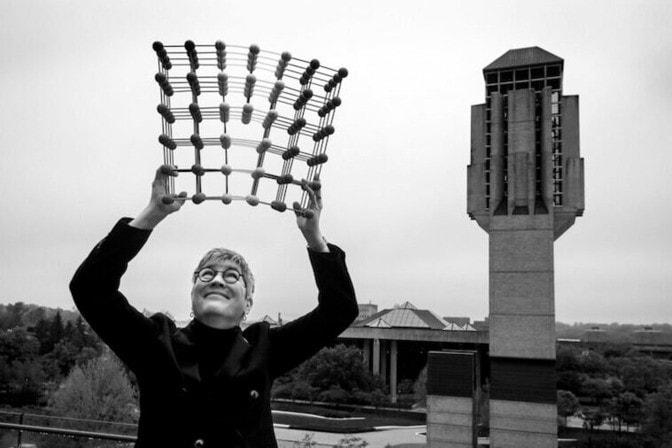
Holm: I am a microstructural scientist. I use computers to understand the microstructure of materials, from aluminum alloys in aircraft to steels used in construction and heavy equipment. My work spans from the atoms all the way up to the scale of the thing we’re making.
I am also a Michigan alum, undergraduate and Ph. D., in materials science engineering and scientific computing. With that degree, for 20 years, I was a government research scientist at Sandia National Laboratories in Albuquerque, New Mexico.
I loved that job. It was a great opportunity to do amazing research with amazing people. But I always wanted to teach. So, when the youngest child graduated from high school, I made the change to academia. And I ended up at Carnegie Mellon University, where I was for about ten years. And then my home place, Michigan, called me to come back here.
Holm: I grew up in Grand Rapids, Michigan. My mother was Polish, the first person in her family to go to college. My father was a pediatrician. I enjoyed all the things that Michigan has to offer—the lakes, the climate, the greenery, the wildlife. And I’m enjoying them again now that I’m back here.
When it was time to go to college, my father said I could go anywhere I wanted, but I would have to prove it was a better value than the University of Michigan. And there was no way to do that. So I ended up going there. I decided to major in engineering because in my junior year of high school Michigan Tech offered a summer camp called Women in Engineering. I had never heard of engineering before. It offered me a week away from my parents, independent and free.
That one week changed my entire course of what I wanted to do with my life. I thought, this takes all the stuff I love—chemistry, physics, math—and puts them together into something useful. Then in grad school, I thought I would be a microscopist, but I was frustrated. My advisor asked me, “Have you ever thought of using a computer to do your work?” I had never thought of using a computer. But I sat down to relearn programming, and I fell in love. On the computer, I make the rules, I write the code. My success and failure is on me. I realized this was how I wanted to probe the universe.
Holm: My research focuses on how the substructure of materials affects how materials behave. Everything around us, everywhere in our built environment, is made of something that’s a material. And pretty much every material has a structure below the level that we can see with our eyes, but above the atomic level. That structure determines how the material behaves—whether it’s strong or weak; whether it conducts electricity or insulates from electricity.
My research has two components. One is physically based simulation and modeling—using computers and the laws of nature to simulate materials and understand their behavior. Using that method, my collaborators and I discovered how the substructure of certain metals evolves in ways that can make or break the properties of those materials.
The second part is machine learning and AI. We use image data from microstructures, but we don’t have millions of images like in typical AI problems. So we use data-efficient methods to work with limited data. We adapt computer vision techniques to materials science. This helps us understand materials in new ways and apply AI even when data is scarce.
Holm: You only know what you know, but what you don’t know is huge. Don’t limit yourself to what you already know. Be open and explore what you don’t know. A child will say they want to be something they already know—teacher, doctor, garbage collector—but there are so many things they don’t know exist yet.
Even in your 20s, there are many things you don’t know exist. The key is to find out what you don’t know, and that’s how you find what you love and want in the world.
There are moments when you get to see how the universe works, and the excitement of that is hard to put into words. In my research, there are papers where I realized I was seeing something new—to me and to materials science. That is deeply satisfying, to think that because of my work we understand a little more about how the world works.
It is also satisfying to work with other people to advance science and the profession. I was never someone who could work alone in a lab; it has always been about collaboration and community. A colleague once said we need to get the word out about what a great job this is—that you can use your mind to do things that help people, work with amazing tools and balance life and work. I loved that perspective.
Holm: The easy answer is AI, but I am not fully convinced. It may be a major challenge or just another tool. A bigger immediate challenge is the erosion of support for scientific research. It is easier to destroy than create, and I am concerned we may be in a cycle of destruction that will be hard to rebuild.
Quotes edited from interview transcript between Elizabeth A. Holm and Marcin Szczepanski.