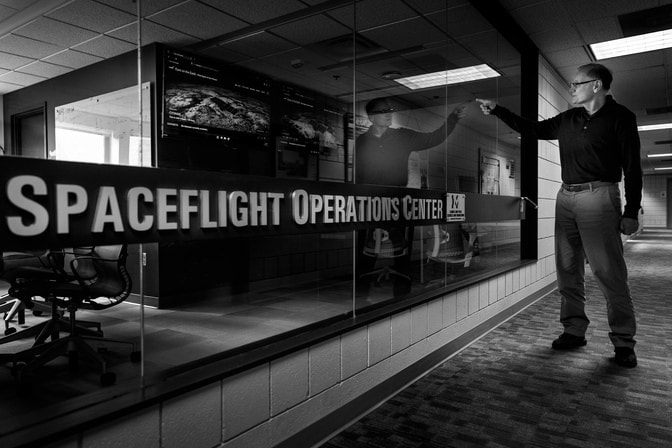
Changing the way we view the Earth
NAE profile: Christopher Ruf, climate and space sciences and engineering.

NAE profile: Christopher Ruf, climate and space sciences and engineering.
Get to know Michigan Engineering’s National Academy of Engineering members.
Earth scientist and remote-sensing engineer Chris Ruf developed a unique radar approach that enabled small satellite constellations to achieve unprecedented visibility into rapid changes in Earth’s environment and weather. Ruf served as principal investigator on NASA’s Cyclone Global Navigation Satellite System (CYGNSS), the first multi-satellite mission to produce high-quality science data from GPS microwave signals reflecting off Earth’s surface. The satellites carried only the receiver half of a radar system—GPS receivers—and used existing GPS satellites as transmitters. The passive approach was cheap enough to fly in eight satellites, offering a remarkable data refresh rate. CYGNSS could sample the same spot on Earth at least 10 times more often than one large satellite could. For these achievements, Ruf was elected to the National Academy of Engineering in 2026. View the NAE profile.
Designed to measure hurricane wind speeds and how they evolve, CYGNSS could see through the intense rain in a storm’s eyewall. Its applications went much further. On land, the GPS signals relate to soil moisture, which can help monitor drought, wildfire, flooding and the ebb and flow of tropical wetlands. Ruf is moving the technology onto drones to fill gaps in satellite coverage.
About Christopher Ruf
The CYGNSS mission paved the way for companies and governments around the world to fly similar systems to forecast or study natural hazards and assess risk. The wildfire-monitoring constellation FireSat was named one of Time’s Best Inventions of 2025, and the California Department of Forestry and Fire Protection is experimenting with how to incorporate its data. The National Oceanic and Atmospheric Administration is testing how CYGNSS-like constellations operated by Spire Global and Muon Space can improve hurricane forecasting, and China and Taiwan have launched their own constellations to monitor typhoons. The European Space Agency launched HydroGNSS in 2025 to monitor drought, flooding and permafrost thaw.
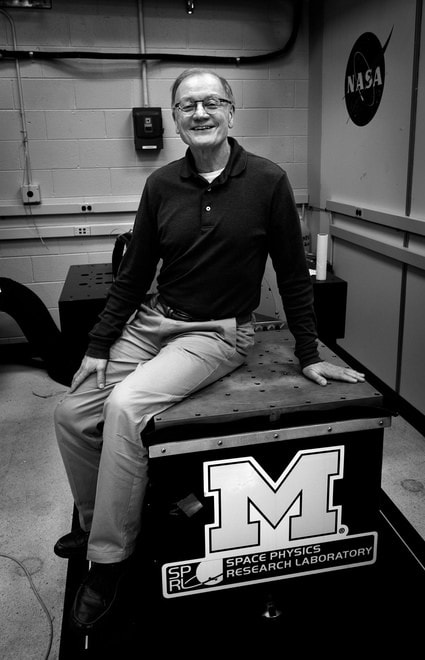
Ruf: One thing I’m often asked in this department is whether I’m an engineer or a scientist. I consider myself more of an engineer. That said, I work in a highly interdisciplinary area that combines both.
I’m often invited to serve on panels studying new ideas. Sometimes those panels consist primarily of scientists working on things like designing better science satellites. In those situations, I’m almost always viewed as the engineer because I have practical experience building things. On the other hand, when I’m working with engineers on design and construction problems, I’m often viewed as the scientist because I spend so much time working with scientists and thinking about the science behind the technology. So I really work at the boundary between engineering and science.
Ruf: Growing up, I always liked math and science and did well in school, and for a long time I assumed I would become a physicist. At the same time, I was deeply involved in music. One of the most influential experiences was playing in rock-and-roll bands and learning electronics from a physics professor who was also a musician. He taught me how to build amplifiers, mixers, synthesizers and other equipment used to create and shape sound. Through that experience, I became fascinated with the hands-on engineering side of music.
After college, I spent three years pursuing music professionally, playing guitar and building audio equipment, which helped me discover how much I enjoyed solving practical engineering problems. Another formative experience was growing up during the Apollo era. Those events left a lasting impression on me. That lifelong fascination with space led me to graduate school, where I focused on developing instruments to measure the atmosphere and oceans from space. Later, my work with NASA and other space agencies shaped me professionally, moving me from designing electronics and sensors to tackling larger scientific questions about weather, sea-level rise, and climate. My experiences in music, engineering, and space science taught me to work at the intersection of building new technologies and using them to better understand the world.
Ruf: In a direct sense, I’ve helped improve weather forecasting. The original goal of our small-satellite mission was to improve hurricane forecasting, and it has succeeded in doing that. Earlier in my career, I worked extensively on improving satellite measurements of sea-level rise. Those techniques have become standard tools used throughout the world to monitor global sea levels. More broadly, I think one of the most important contributions of this work is helping society better understand how Earth’s environment is changing. A solid scientific understanding of our planet helps inform decisions about energy policy, environmental management, and long-term planning. On the technology side, I’m proud that our work helped demonstrate the value of small satellites and contributed to the growth of an entirely new approach to Earth observation.
Ruf: We know how to address many of these challenges. From an engineering perspective, many solutions already exist. The larger challenge is political. The question is whether societies are willing to make the investments and policy decisions necessary to implement those solutions. I believe that much of our future depends on political leadership and public willingness to support long-term investments in infrastructure and sustainability.
I hope we make better decisions politically and become more willing to invest in long-term solutions. I think there are many talented younger leaders who understand these issues and want to address them. I also think education plays an important role. Many of our challenges are interconnected—education, political decision-making, public understanding of science, and long-term planning. If we can make progress in those areas, I believe many of our larger problems become much more manageable.
Ruf: One of the most valuable experiences in my own development was learning practical, hands-on skills. Building audio electronics for my band taught me a tremendous amount about how real systems work. I learned how to troubleshoot problems, use tools, and build things that actually had to function in the real world. Those experiences complemented the theoretical education I received in mathematics, physics, and engineering.
Twenty years ago, when I interviewed prospective Ph.D. students, I would often ask whether they repaired their own cars or bicycles. The strongest engineering students almost always did. Today, far fewer students have those kinds of experiences. I think that’s unfortunate. Mathematics is essential. Physics is essential. Advanced technical coursework is essential. But students should also learn how to build things with their hands. The combination of theoretical knowledge and practical experience is incredibly powerful.
Ruf: Without question, it’s seeing so many other organizations build on the work we started. The satellites were designed to last only two years, but they’ll reach their ten-year anniversary this fall. They’re far beyond their intended lifespan and will eventually stop operating. If our mission were the end of the story, that would be a little sad. But that’s not what’s happening. Today there are dozens of other satellites in orbit built by companies, universities, and space agencies around the world that are using and extending the concepts we demonstrated. I know many of the people leading those efforts, and their programs continue to grow. Seeing that work continue and evolve long after the original mission has exceeded its design life is incredibly rewarding.
Quotes edited from interview transcript between Chris Ruf and Marcin Szczepanski.