Self-driving cars: near-miss driving data can expedite AV algorithm training
New University of Michigan-led research could boost safety performance of AVs.

New University of Michigan-led research could boost safety performance of AVs.
The safety performance of autonomous vehicle (AV) algorithms is boosted 90% using simulation data that better incorporates near-miss incidents with outright failures, according to new research led by University of Michigan Engineering.
The finding could help accelerate testing and data gathering to prove AV technology is safe, boost public confidence in the vehicles and move the auto industry along the long-promised path toward Level 4 and Level 5 automation. The work was funded in part by the National Science Foundation and published earlier this year in Nature Communications.
The promise of self-driving cars is that they could greatly reduce the roughly 40,000 deaths by vehicle that occur annually in the United States. But despite historic investments of more than $160 billion in AV technology, the public’s acceptance of driverless vehicles has remained stubbornly low. Safety concerns lie at the heart of this reluctance.
The algorithms responsible for safety, which control the movement of AVs, need to be “trained” to safely operate vehicles in all kinds of traffic situations. That training comes in the form of data collected from real-world AV testing, computer simulations and combinations of the two.
Once trained, AV control algorithms are tested to determine where the problems lie. Then it’s back to training the algorithm to address those problems.
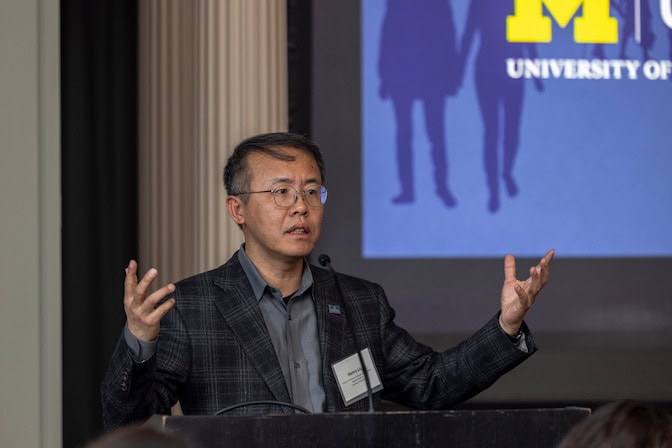
“With AI, we have something called the seesaw problem—you find a problem, and then you run simulation variations to train to solve the problem,” said Henry Liu, director of both Mcity and the University of Michigan Transportation Research Institute (UMTRI). “Then, unfortunately, sometime after the training, another unanticipated side of the same problem arises, or even completely new problems that have never appeared before.”
In this situation, programmers have two options: design an entirely new neural network architecture or change the training data. Since the first option is time- and cost-prohibitive, the instinct is to load up on crash data to train the network what not to do. But focusing on crash data excludes incidents that are at least as valuable.
“What we’ve learned is that the training is more effective when you’re utilizing data from both crashes and near misses,” Liu said. “They are both safety-critical scenarios, and a near miss means the vehicle was able to maneuver through a situation successfully without a crash.
“In simulated testing, near misses occur a thousand times more often than crashes. Bundling failures and near misses improves overall performance dramatically.”
The team tested their approach in the Mcity Test Facility, achieving 90% improvement in the vehicle’s safety performance.
The study builds on previous work by U-M researchers, which helped address the “curse of rarity” in AV testing—the fact that safety-critical events like crashes and near misses are statistically rare. On-road testing would require hundreds of millions or billions of miles to gather enough information from real crashes and near misses to be useful. U-M’s use of artificial intelligence (AI) to train AVs helped reduce testing miles required by 99.9%.
The research was funded by the Center for Connected and Automated Transportation at U-M and the National Science Foundation.
U-M researchers Haojie Zhu, Haowei Sun, Boqi Li and Shengyin Shen contributed to the work as well as researchers from Tsinghua University.