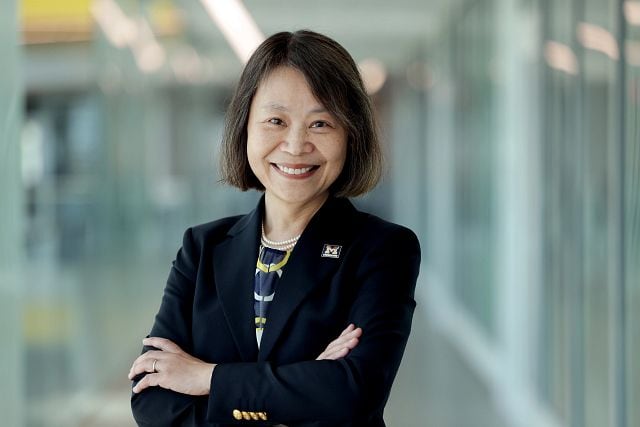
Get to know the new dean of University of Michigan Engineering: Q&A with Mingyan Liu
Dean Liu reflects on lessons learned as a researcher, chair, and collaborator.

Dean Liu reflects on lessons learned as a researcher, chair, and collaborator.
From research that has influenced cybersecurity, risk management, and decision-making systems, to working through crisis as a department chair, University of Michigan Engineering’s new Robert J. Vlasic Dean of Engineering Mingyan Liu’s time at Michigan has focused on applying her expertise to complex real-world challenges. In this conversation, Dean Liu reflects on lessons learned as a researcher, chair, and collaborator, and shares her perspective on some of the greatest opportunities and challenges facing engineering education today. Liu is also the T.C. Chang Professor of Engineering and a professor of electrical and computer engineering.
My favorite subject in high school was actually physics, and I was very good at it. But entering college in the early 1990s, everyone told me there were no jobs in physics, so I chose the next best thing: the “physics-adjacent” major, electrical engineering. I came to really enjoy the subject, especially the heavy use of mathematics in communications and signal processing, which is my background, to solve real-world problems.
Broadly speaking, my research is in the area of networked systems, and that includes networks of physical communication devices as well as networks of information sources and the impact of decision-making on those systems. This shows up in a variety of ways, including how to allocate scarce resources among potentially competing individuals or agents, how agents make decisions in environments that are connected, collaborative, or competitive, and how to design incentive structures to induce more socially desirable behaviors. For example, in the cybersecurity domain, we seek to understand how one firm’s decision on cybersecurity practices or spending affects others, and how mechanisms such as cyber insurance or software audits can influence decision-making.
I was also a department chair for five years, of which close to four were spent during and after the pandemic. This taught me how to lead during a time of crisis and how to recover from one, as well as the importance of communication, transparency, and common sense. It also underscored the importance of activating and trusting the many talented people, faculty, and staff around us, and treating each other as equals. Above all, it taught me how important it is to keep our eyes on the horizon, to not lose sight of our ultimate vision and mission, and to look for ways to turn every crisis into an opportunity.
I also believe that a healthy dose of criticism and friction is both necessary and beneficial to any high-functioning team, and as dean, I’m committed to remaining connected with our community so I can hear important feedback on how we’re doing and opportunities for growth and change.
There’ve been many challenges facing higher education in general (and public higher ed in particular) over the past decade, including rising mental health issues, the increasing financial burden on our students and their families, and the growing demand on timely degree completion. More recently, there’s grade inflation, increasing demand for accommodation, and the availability of (and lack of consensus on the use of) AI tools.
An area of friction between several of these challenges is the balance between a student’s desire and pressure to get a job and get it fast (which has contributed to grade inflation and over-reliance on AI), and our goal to provide a well-rounded, “whole person” education that will benefit them for the rest of their lives.
As a leading engineering college at a leading public institution, we understand that the majority of our students see their college degree as a necessary step to a successful future career — and we are doing everything we can to put them on that path. At the same time, we hope our students will also see their college education as much more than a means to an end. We want our students to take full advantage of everything this college has to offer so their educational experience prepares them to be successful, independent adults who go on to make the world a better place. We want our students to actively prepare for their next step while embracing and exploring all that’s possible during their time on campus.
Like any other powerful tool, AI is being used for both good (e.g., to vastly accelerate scientific, medical treatment, and drug discovery, or to automate and replace human tasks that used to be performed routinely in hazardous environments) and bad (e.g., to amplify misinformation and bias, and to replace activities that may be good for our cognitive, psychological, and physical health). Our goal is to engage with AI responsibly to enable and accelerate innovation for the benefit of society, and to educate our students to use these tools responsibly and for good. Clearly, this is a fast-changing landscape, so there may yet be many more disruptions coming our way that we will have to adapt to, but what has not changed and will not change is our mission to deliver excellence in research and education. And on the latter note, we as a college have always prioritized experiential and hands-on learning and the teaching of many skills as part of the “whole person” education, including critical thinking, creativity, leadership, as well as caring for one another and working under pressure and in adverse or ambiguous situations. These leadership skills are more important than ever.
One distinct memory is shaking hands with hundreds of graduating students at my first commencement appearance as a department chair. Our students’ jubilance was absolutely unmistakable and infectious, and is what makes our work worth doing.
I have very bad hand-eye coordination. When I aim for the dartboard on the wall, people in the room duck.
Against the backdrop of the World Cup, I learned the origin of the word “soccer”: it originated in the UK (in the late 1800s) as a short/slang for “Association football” → “Assoc” → “Soccer” to distinguish from “Rugby football” → “Ruger.” I had always thought soccer was a term coined in the US to distinguish it from (American) football. So it was really “Soccer vs. Ruger” rather than “Soccer vs. football”!
I’m deeply honored to serve as the dean of this great college. It is a privilege and responsibility that I take very seriously. I enjoy working with the many talented people around me all day, every day, knowing we share a common goal. We all want this college to be even greater, and because of that, it will be.