Scholarship enables undergraduate to pursue passion for naval reporting
Reporting on the Great Lakes maritime industry became possible with reduced financial burden.

Reporting on the Great Lakes maritime industry became possible with reduced financial burden.
When money is on the mind, it sometimes distracts people from following their true passions. A scholarship fund from the American Bureau of Shipping (ABS) helps ensure that naval architecture students at the University of Michigan don’t have that problem.
Since 2009, ABS—an organization that provides classification, certification and verification services for marine and offshore assets—has funded 270 scholarships that provide tuition and housing support for naval architecture and marine engineering undergraduates. Students that maintain a GPA of 3.0 or higher are eligible.
“One way we fulfill our mission to protect seafarers, offshore operators, marine assets and the environment is by investing in education and supplying the industry with more talent,” said Chuck Kemper, ABS Senior Vice President and Chief Human Resources Officer.
U-M is one of 19 institutions in the United States that receive scholarship funds from ABS, but some of the highest level of support went to U-M for the quality of its students and maritime research, Kemper said.
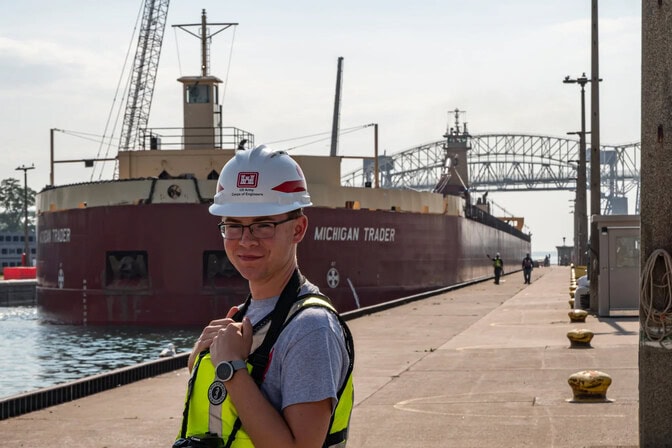
For students like Brendan Falkowski, a current senior, the scholarship means more time to devote to professional development and extracurricular activities.
“Things like the ABS scholarship really help alleviate the financial pressure,” said Falkowski, who also plays trumpet in the U-M marching band. “I would probably have had to look at getting a job to support getting my education.”
The reduced financial burden has given Falkowski time to serve as a volunteer undergraduate advisor on a University-led project to develop a strategy to bring improved, sustainable maritime infrastructure to the state of Michigan. He has also used his free time to advance Shipwatcher News, a newsletter about the Great Lakes shipping industry.
Falkowski started the publication as a handwritten pamphlet in the fourth grade. It has since grown into an online, quarterly newsletter with three contributing writers and 1,400 subscribers. Recent issues have run three to four long-form stories in addition to several briefs on Great Lakes Maritime news, called “Laker Reports.” Each article requires time for research, reporting and conducting interviews, in addition to Falkowski’s other duties as owner and editor.
Sailing on the high school team and with his family are the source of Falkowski’s passion for naval architecture. His family kept a boat in a marina in Muskegon, Mich. While frequenting the marina, he watched freighters moving cargo in and out of a nearby commercial port. He loved learning about what the visiting ships were carrying, as well as their histories.
“What’s unique about the Great Lakes is that the ships that trade here are considerably older than what you would see on the oceans today, so they have a lot more history,” Falkowski said. “Engineering-wise, they’re also a different design than what you would typically see on the oceans. I got really interested in the uniqueness of my home region, and I really dug into learning more about it myself and sharing it with others.”