Building the moments that build futures
ECE alum is making sure that education works for all.

ECE alum is making sure that education works for all.
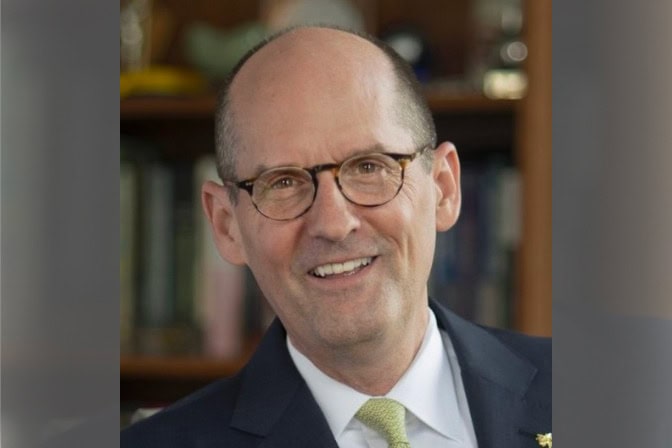
In high school in 1970s Rochester N.Y., Steven McLaughlin (PhD ECE ’92) had never thought much about math or engineering–until a five minute chat with one of his teachers. Known as the school’s “cool” physics teacher, he recognized McLaughlin’s proficiency in math and science and offered up the idea of engineering as a path forward.
“He asked me ’Have you ever considered engineering?’ and my response was ’What’s that?’” McLaughlin said. “At some point in that conversation, electrical engineering came up, and I pretty much just fell into that. And it turned out that I love it.”
“Five minutes matters.” The phrase has become a go-to when McLaughlin is asked to give speeches and interviews, and he has spent much of his career working to create those key moments for others.
“Whenever I talk to faculty or stand up in front of people I remind them that five minutes matter. We think that it’s these epic moments that are responsible for changing lives, but it’s often the little things, the small moments that can be transformative.”
In April 2025, the saying took on new relevance as McLaughlin was named the 14th president of The Cooper Union for the Advancement of Science and Art.
Cooper Union affords McLaughlin the opportunity to continue providing transformative opportunities for others. It was founded in 1859 as a private institution with the intention of providing a world class education that was “open and free to all.” It remained a tuition-free institution for a century and a half until 2014, when the administration began charging students half the cost of tuition.
McLaughlin arrives to steward Cooper Union through the final three years of a ten-year plan to return to offering full-tuition scholarships to all undergraduate students.
“As higher education continues to change at an accelerated pace, we have identified an educator and proven leader who is known for his transformative impact and high degree of emotional intelligence,” said Jamie Leavitt, who served a co-chair of the presidential search committee, in a statement released in April 2025. “Steve is a champion of students and, throughout his career, has sought to create learning experiences for students to grow as creative, ethical, globally aware, technologically sophisticated leaders who can define and solve problems.”
Even in his undergraduate days at Northwestern University, McLaughlin looked for ways to create opportunity for others. He often took the time to walk other engineering students through course material in the day or two before exams.
“I loved that,” he said. “For me, it was a way of studying too, but being able to explain stuff to others… there’s nothing better.”
After earning a master’s degree from Princeton University, McLaughlin moved to Washington D.C. where worked in a tutoring program. He helped children from low-income neighborhoods improve their test scores, making them eligible for full scholarships to some of the area’s elite grade schools.
The experience steered McLaughlin to a career as a college professor. He earned a PhD from U-M in electrical engineering in 1992 and has remained affiliated with the university in various roles, including as a member of the leadership advisory board.
After serving for four years as an assistant professor at the Rochester Institute, he joined Georgia Tech in 1996 and remained there for more than 29 years. He has consistently worked to expand engineering offerings, including during his term as the dean and Southern Company Chair of Georgia Tech’s College of Engineering.
McLaiughlin relocated to Lorraine, France in 2004 to rejuvenate Tech’s presence there. Despite planning on staying for only three months, he remained there for three years. In 2011, he received the Chevalier dans l’Ordre Nationale de Merite (Knight of the French Order of Merit), the highest civilian award given by the Republic of France.
Just over a decade ago, he co-founded a program called CREATE-X, with the goal of inspiring and equipping students to start their own companies. The program generated more than 600 student-led startups.
All of which is to say that the chance to lead Cooper Union, particularly during its return to free tuition, seems like a position tailor made for McLaughlin.
“Right place at the right time,” he said. “In many ways, universities have lost the trust of the public and we in academia recognize that. They have a social contract—to provide free, fair, high-quality, accessible education, plain and simple.”