
Nuclear in a new light
For those who have grown up with plentiful electricity, it’s difficult to imagine life without it. We might hear about fragile grids, shifting power sources and growing demand, but those things remain abstract concepts; the light still comes on when we flip the switch.
But for a young Aditi Verma, growing up in India in the 1990s, the need for better energy infrastructure was anything but abstract.
“Even in the big cities, there were blackouts and brownouts all the time,” she said. A voracious student, she studied for high school exams by flashlight or candlelight when the power failed.
Those experiences, as well as her penchant for both physics and public policy, drew her to nuclear energy research, first as an analyst with the OECD Nuclear Energy Agency, then to a fellowship at Harvard, and finally to University of Michigan Engineering as an assistant professor of nuclear engineering and radiological sciences (NERS) in 2022.
“Electricity is such a fundamental driver of growth and well-being,” she said. “And nuclear in particular incorporates physics with policy and ethical challenges that, if they could be solved, have so much potential for good. When I look back at growing up in India, that’s what’s most salient for me.”
Today she’s playing a role in nuclear power’s biggest resurgence in decades. Global investment has risen by more than 50% over the past five years. Growing electricity demand from technology such as AI data centers and electric vehicles have made the economics of nuclear power more attractive. In addition, studies suggest that meeting the world’s carbon reduction goals without nuclear would be difficult and costly.
The United States has implemented a series of regulatory changes to streamline the Nuclear Regulatory Commission’s (NRC) licensing process for new commercial reactors. It has also developed the Reactor Pilot Program, designed to fast-track the approval and construction of demonstration reactors by regulating them through the Department of Energy (DOE). Because the DOE’s mission has traditionally tended toward promotion, rather than regulation, of new technology, it’s projected that the new structure will get new ideas off the ground faster.
While former NERS department chair Todd Allen (PhD NERS ’97) is enthusiastic about the uptick in nuclear technology interest, he believes that rushing new projects forward is the wrong approach. Allen is also associate dean for research at the College and the Chihiro Kikuchi Collegiate Professor of Nuclear Engineering and Radiological Sciences.
A retired U.S. Navy captain who spent more than three years on a nuclear submarine and decades at national labs and nuclear think tanks, Allen has a deep knowledge of nuclear industry culture. He and others argue that the new momentum would be better used to power a fundamental reset in the relationship between the industry and the public. Allen says such a reset is long overdue, as public mistrust and bungled community engagement have scuttled U.S. nuclear projects for decades. Perhaps the most prominent example is the Yucca Mountain nuclear waste repository project, where a lack of community engagement contributed to the project’s abandonment after decades of work and billions of dollars in investment.
“If you go back into the history of nuclear power generation, the first nuclear power plants were essentially submarine technology scaled up into these very, very large machines,” Allen said. “And I think the industry has had a sort of stereotypical military mindset of ‘Be quiet, don’t talk to people about what you’re doing.’ But the number of new projects on the horizon is a huge opportunity for the industry to engage in a different way. And if the first few projects are successful, mayors will start talking to each other and help the trajectory of future projects. On the other hand, if they’re executed poorly, that will make future projects that much harder.”
A new generation of smaller, less complex reactors could aid that engagement. Because they require less land and are more flexible in design, their proponents believe that they could be used to earn public acceptance by more precisely tailoring projects to the places that host them–with community input that starts before sites are selected. Mostly developed by a groundswell of private companies with government support, their proponents believe they will be faster and cheaper to build, and could be sited in a wider variety of locations.
Two broad categories of advanced reactors have emerged; the first is microreactors, which are intended to be completely factory-assembled. Capable of producing up to 50 megawatts, it’s envisioned that they will be shipped to their final destinations by truck, where they will power places like data centers, military bases and small, remote towns for years with no need for on-site maintenance or refueling.
The second category is small modular reactors, or SMRs, which occupy a middle ground between microreactors and traditional nuclear power plants. They generate 300 MW or less—more than microreactors but still a fraction of the 700 MW or more produced by traditional power stations. With components manufactured in a factory, then assembled at the plant location, they could provide grid-scale power in a much smaller geographical footprint than a traditional power plant, with a degree of standardization that makes them less complex to site, build and operate.
A variety of fuel and process technologies are under development, but one thing all advanced reactors have in common is passive safety features that make them what those in the industry call “walk-away safe.” Their fuel and cooling systems are designed to keep them safe for long periods of time without human intervention in the event of a natural disaster, technical malfunction or other interruption.
Fission for the road: Microreactors
Materials science and engineering alum Rita Baranwal (MS MSE ‘96, PhD ‘98) is deploying what could be the world’s first mass-produced microreactor in her role as chief nuclear officer at California-based startup Radiant. Called Kaleidos, the company’s design is being developed under the Reactor Pilot Program.
For Baranwal, the new energy in the nuclear space isn’t just an idea; it’s a tangible force that drives her work day in and day out. Her role at Radiant is the culmination of a career journey that has taken her from fundamental science and engineering roles toward on-the-ground impact.
|
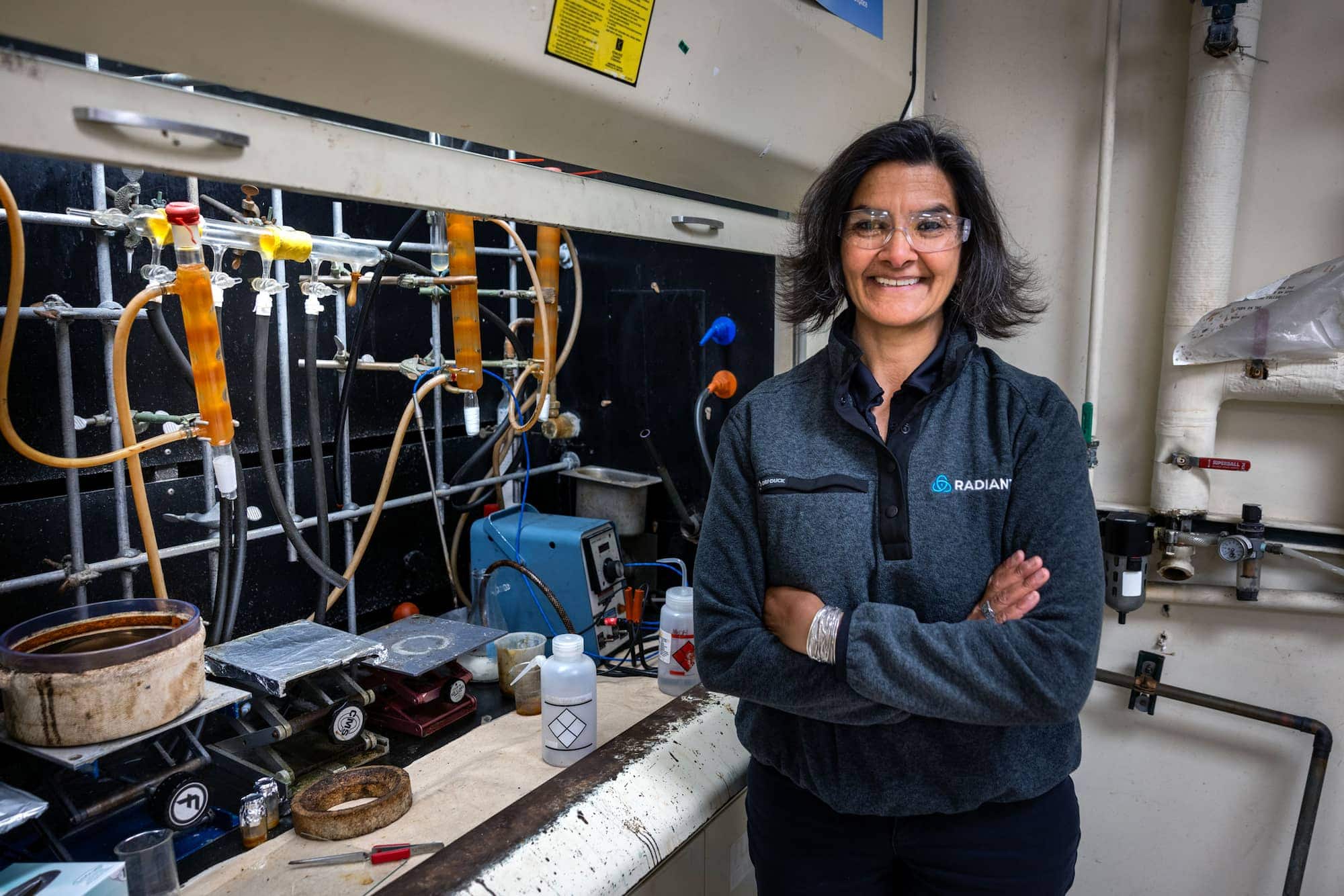
Rita Baranwal poses in a North Campus lab. PHOTO: Marcin Szczepanski
“I’ve been told my entire career, ‘You’re in the wrong part of the industry,’” Baranwal said. “I’ve been told I have much more startup DNA than what’s expected in traditional nuclear culture. So I feel like I’m finally in the right place. It took me a long time to get here.”
The Kaleidos reactor is designed to use TRISO fuel. Made up of poppy-seed-sized particles, TRISO encapsulates a uranium kernel inside four layers of carbon and silicon carbide materials. The protective layers are capable of containing the fuel’s radioactive material even at extreme temperatures. The kernels are encased in 1-inch-long graphite rods called compacts, and stacks of compacts are loaded into a structure called a monolith inside the reactor core.
Kaleidos Microreactor – Digital Rendering
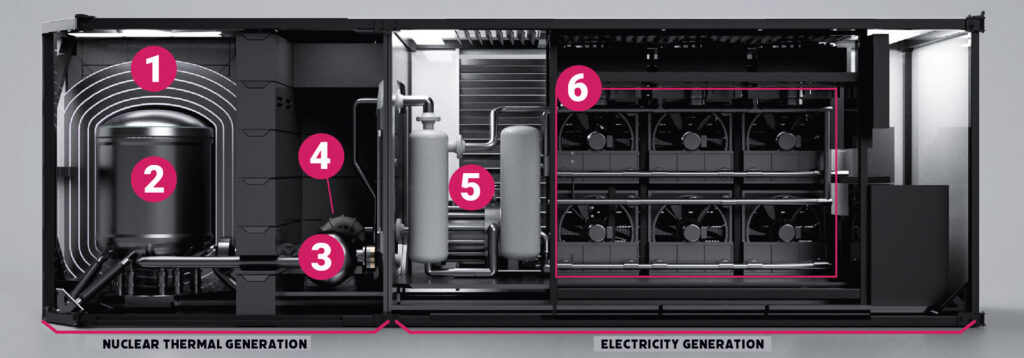

Shielding

Helium circulator

Reactor core

Turbine alternator compressor

Primary heat exchanger

Heat sinks
“When you talk about the layers around the fuel particle, the particle being in a compact, the compact being in a monolith, the monolith being in the reactor, the reactor having shielding, and that whole thing being in a container, it’s almost 10 layers of defense that’s keeping the fuel safe,” Baranwal said.
Kaleidos will use pressurized helium as the coolant that transfers heat from its radioactive core to a heat exchanger, where it could be used to heat liquid or gas for a turbine or for industrial process heat. A noble gas, helium does not pick up radioactivity from the core, meaning that a leak would not release radiation into the atmosphere. And because helium remains stable at very high temperatures, the reactor can run hotter than those that depend on water, boosting efficiency.
While helium cooling might sound exotic, it’s an established technology that has been used in five experimental reactors around the world, starting with Pennsylvania’s Peach Bottom Atomic Power Station in 1967. While the technology is considered safe, making it economical has been a challenge; Kaleidos would mark its first use in a commercial microreactor.
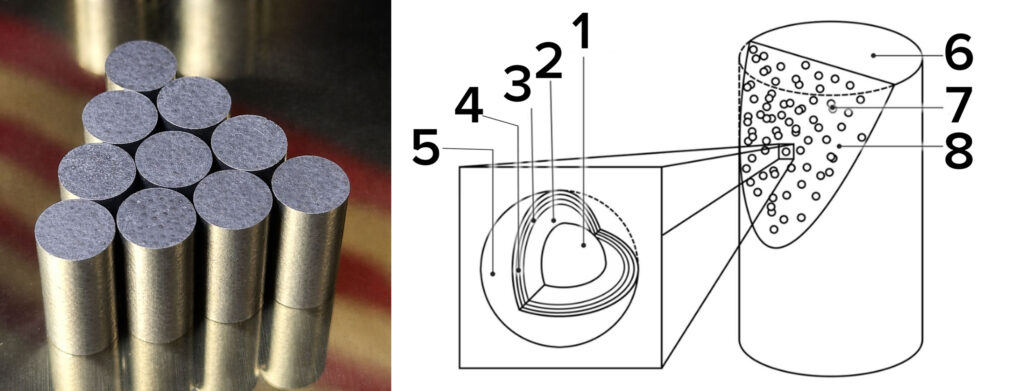
1– Fuel kernel
2- Carbon buffer layer
3- Inner pyrolitic carbor layer
4- Silicon carbide layer
5- Outer pyrolitic carbon
6- Fuel compact
7- TRISCO-coated fuel particle
8- Graphite matrix
The reactor core also incorporates an air jacket that provides passive cooling. That cooling, combined with the safety margin of TRISO fuel means that, even with a complete loss of its helium coolant, the reactor could automatically shut down and remain safe indefinitely without human intervention.
Radiant is building its first Kaleidos reactor at its headquarters in El Segundo, Calif., and plans to conduct a fueled test of its reactor design by July 4, 2026 at the Nuclear Reactor Innovation Center’s Demonstration of Microreactor Experiments (DOME) facility at Idaho National Laboratory. It would be the first fueled test of a new reactor design in the U.S. in 50 years.
The U.S. Air Force has signed up to be Radiant’s first customer; if the tests go as planned, the first four reactors are destined to power air force bases. Ultimately, Radiant hopes to have the capacity to build 50 Kaleidos reactors per year at its factory in Oak Ridge, Tenn.
Verma points out that microreactors’ small size, portability and lack of required on-site maintenance could make them feasible for communities that couldn’t or wouldn’t host a traditional nuclear project.
“If you have a microreactor that can be transported by truck, nuclear infrastructure becomes something that a community can sort of try out,” she said. “It’s now possible to install a reactor and take it out a few years later if things don’t go well. Or if it does succeed, it’s possible to add capacity in a much more modular way than is possible with traditional reactors.”
Baranwal says microreactors could also bring a new source of energy to areas that need electricity but don’t have the infrastructure or space for a traditional reactor project.
“There are about a billion people around the world that don’t have access to reliable electricity,” she said. “This is a product that could help alleviate some of that by providing baseline access to clean electricity and heat, thereby enabling more prosperous lives.”
Small package, big power: Small modular reactors
The commercialization of small modular reactors is further along, with two in commercial operation and a handful in various stages of licensing and construction around the world. In the U.S., two projects are vying to become the first to begin commercial operation. Holtec International is arguably in the lead; the company is working to bring two of its SMR-300 reactors online in 2030 at the existing Palisades Nuclear Generating Station on Michigan’s west side. Palisades was originally completed in 1972, decommissioned in 2022, and in 2025, became the first U.S. reactor ever to be restarted after being decommissioned.
The SMRs will add 640 MW to the 740-MW capacity of the existing reactor. The SMR-300 is a pressurized light-water reactor, similar in principle to traditional large reactors, and it’s believed that its familiar technology will speed the licensing and permitting process and enable it to get up and running quickly once it’s built.
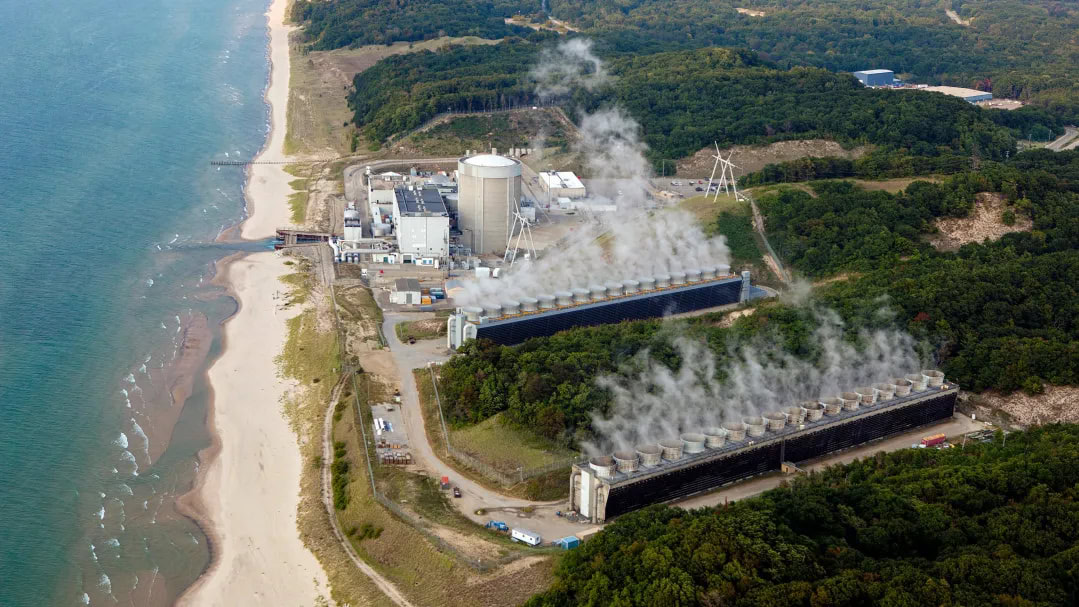
Comparing the SMR-300 to the existing Palisades reactor reveals how reactor technology has changed over the decades. The older reactor uses a pressurized water design, which uses water to cool the reactor core and transfer its heat to a secondary coolant loop, generating steam that runs the power generating turbines. Water circulation relies on electric pumps, which have multiple backup systems to keep them running in the event of a power outage or other emergency.
While the SMR-300 will also use pressurized water for cooling and heat transfer, its system relies on natural circulation driven by gravity, steam pressure and the heating and cooling cycle of the water. In addition, the reactor assembly will be surrounded by more than a million gallons of water, providing additional passive cooling. These features would keep the reactor safe for days without human intervention, even in the event of a coolant loss or other malfunction.
In Kemmerer, Wyo., a second project is already under construction. TerraPower’s Natrium reactor would add a single 340-MW sodium-cooled fast reactor to the site of an existing coal plant that is scheduled to be retired in 2031.
Sodium reactors are a more radical departure from tradition than the Holtec reactor, using liquid sodium for coolant and heat transfer. The molten metal is circulated by pumps but will operate at much lower pressure than the water in traditional reactors. In addition, the molten sodium’s ability to absorb heat without boiling means it can stay safe even if pumps fail. The molten salt can also be used for energy storage, sitting in storage tanks until it’s needed to produce electricity. And because the water used to generate steam is separate from the molten sodium, it does not become radioactive. This reduces the risk of a release of radioactivity in the event of an accident, and means that power generation can be done separately from the plant’s nuclear operations.
A commercial sodium reactor has been in operation in Russia since 1980, and the U.S. has extensive experience with demonstration reactors. The Kemmerer project would be the first commercial sodium reactor to begin operation in the U.S. It’s predicted that a longer testing and approval process will bring it online after the Holtec reactor.
Rebuilding the nuclear workforce
In addition to new technology, an expanded nuclear energy presence in the United States will require a new generation of workers. That’s a challenge in an industry that has been in stasis for decades. The dearth of new projects has meant that, as old workers retire, new workers haven’t come in to pick up the mantle, leading to a brain drain in the space. While interest has begun to pick up again, fostering a different kind of nuclear culture will take new ideas. And, as the oldest and most highly ranked nuclear program in the country, U-M is uniquely positioned to provide them.
Brendan Kochunas (PhD NERS ‘13), a U-M NERS associate professor, is working to find new ways to give NERS students the experience they need. In the process, he has brought new attention to one of Michigan Engineering’s most storied landmarks: the Ford Nuclear Reactor (FNR).
“It’s much harder to get exposure to real-world equipment in nuclear than it is in other engineering fields,” Kochunas said. “It’s not easy to go onsite and tour and see the technology. But I think figuring out how to increase access for people to see these things and get hands-on experience is really important.”
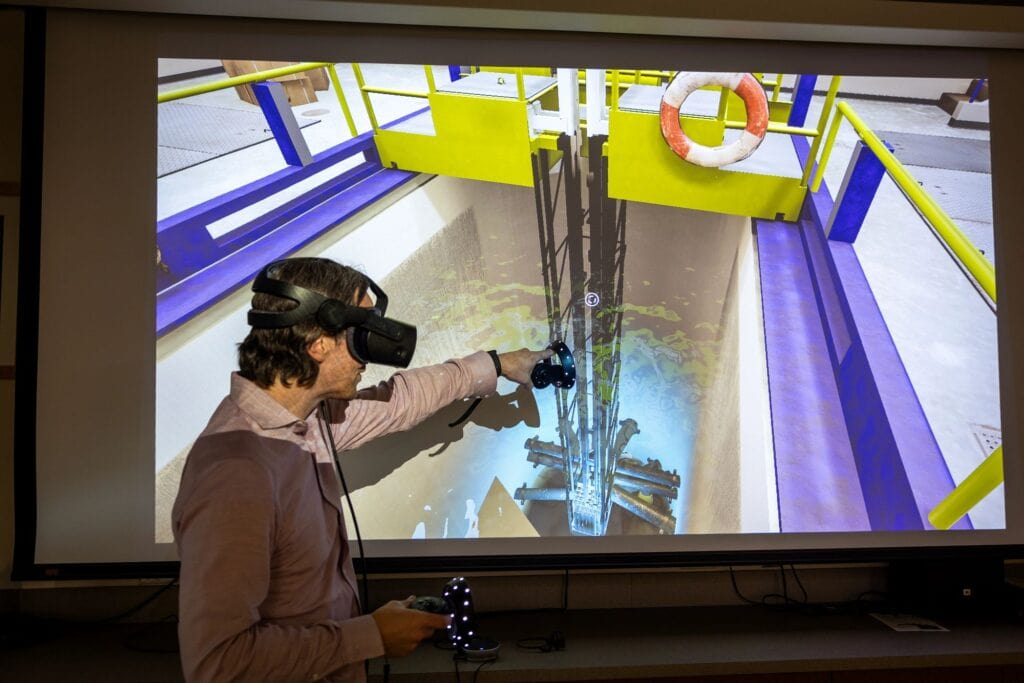
Kochunas has worked to make that happen by building a virtual reality model of the FNR. Completed in 1957, the reactor was the crown jewel of the Michigan Memorial Phoenix Project, a student-led, functional memorial honoring the members of the U-M community who died in World War II. The 2-MW reactor was used to study medicine, cellular biology, chemistry, physics, mineralogy, archeology and anthropology. It also introduced generations of NERS students to hands-on experimentation.
In 2003, the FNR was decommissioned due to shifting research and teaching demands and increasing costs. Today, the reactor building on North Campus has been remodeled into laboratory and collaborative space for the Michigan Memorial Phoenix Energy Institute. And since 2023, students have been able to virtually walk through the reactor building, power the reactor up and down and conduct a variety of educational experiments.
The virtual FNR software is also available free of charge to educators or researchers, for use on their own VR equipment. The effort was one of the educational innovations that won Kochunas the John F. Ullrich Education Excellence Award from Michigan Engineering in 2026.
“I think tools like the virtual reactor can help show students that nuclear isn’t just about theory and physics, it’s about building real things,” he said. “In a lot of ways, you’re solving similar engineering problems to what you’d find in mechanical or civil or other engineering fields.”
At U-M, interest in nuclear engineering is picking up, with a 25% increase in enrollment over the past five years. Recognizing the growing interest, the department launched a minor this year to expose more students to opportunities in the field.
“Young people are getting the message, and we anticipate there will be good jobs for them when they’re ready, including here in Michigan,” Allen said.
Making nuclear work for communities
Leading the kind of philosophical shift that Allen and Verma envision will require more than just getting new students in the door. It will require equipping them with the tools to lead a new way of thinking in the industry. And that starts with new siting, ethics and implementation strategies for nuclear infrastructure.
Traditionally, nuclear projects in the U.S. have been sited without initial public input. Communities often don’t learn they’ve been selected until a company buys the land for a project. Developers then engage communities only after decisions have been made in a process that’s sometimes called “decide, announce, defend.”
The approach stems from 1960s nuclear industry-sponsored research that found that the public was “irrational” about the risks of nuclear energy and concluded that engineers, not the public, should determine what is an acceptable level of risk.
Over the decades, however, “decide, announce, defend” has brought community pushback and led to a long history of scuttled projects. Verma points to the nine U.S. states that currently have moratoria prohibiting new nuclear development.
“These moratoria came about after nuclear sites were selected without first consulting the communities that would host them,” Verma said. “These were communities that absolutely did not want these facilities, and because they didn’t have a say in the process, they felt they had to go outside the process and protest. And those protests grew into moratoria at the state level. I think if we don’t change the process, we’re in danger of repeating that.”
Verma is championing an approach that has already had success in other spaces. Called “participatory design,” the technique emerged in 1990s Sweden as a way to improve workplace technology. Its key innovation is that it works closely with the end users of new technology, designing and implementing in close collaboration from start to finish. It has since spread to other fields including healthcare and urban planning.
Verma’s research suggests that participatory design could be applied to nuclear infrastructure projects, in the process of making key decisions about the designs of nuclear facilities and their impacts.. It could match projects to places based on input from the communities themselves as well as from a broad swathe of experts, including sociologists and anthropologists in addition to engineers and other technical experts.
She points to Sweden, Finland and Canada as promising examples; they are the only countries that have successfully selected sites for long-term nuclear waste depositories. All three used principles similar to participatory design, consulting and engaging with prospective host communities throughout the planning process.
Verma believes that participatory design principles could be a way to realize the potential she envisioned as a student back in India. In 2023, she launched a new class that introduces the principles to first-year NERS undergraduates. The “Socially Engaged Design of Nuclear Energy Technologies” class begins with the fundamentals of nuclear energy systems, including nuclear physics, fusion and fission. Students then work with community volunteers from across Southeast Michigan to design a hypothetical nuclear reactor project. Through extensive interviews, students learn how people in communities with nuclear projects think about energy, the place of energy in their lives, which types of projects might be desirable and why. They then hold workshops to design the nuclear energy facility together.
“We didn’t know what to expect, honestly, when we invited people to participate in these workshops; we know that nuclear issues can be very polarizing,” Verma said. “But it was really interesting to see how they worked with the students. They had ideas not just about the immediate facility, but how it could be made to fit into the arc of their community’s history. That kind of information is a valuable resource that engineers can’t provide on their own. And by the end of the project, the community members were very invested in their ideas—a lot of them continued to write to us after the workshop ended.”
Allen points out that, while change has historically come slowly to the nuclear industry, every new project represents an opportunity to implement new ideas. And in a more nimble nuclear space, those ideas are more likely to find traction.
“Historically, the U.S. has developed nuclear by the government deciding what the next thing was going to be, but today it’s a very different world. I’ve lost count of how many reactor companies there are now,” he said. “Some of them are going to fail, and I think we need to accept that as not a failure of nuclear, but as a success in whittling down to the best product in the end. It means the process is working.”