Storied U-M landmark reopens
Photo Essay by: MARCIN Szczepański
STORY by: Derek Smith
Centuries-old ceremony ushers the nation’s first university testing basin back into service
Engineers are not generally known for their superstition. But naval engineers do attach a certain mystique to the water inside “tow tanks,” the massive test basins where, for centuries, engineers have tested new ship designs for seaworthiness. Legend holds that the water itself soaks up a bit of new knowledge with each new test.

Students, staff and faculty from University of Michigan Engineering pour donated water into the tow tank with visitors from Germany and Sweden. Standing at the front of the carriage (from left to right) are David Dowling, department chair of naval architecture and marine engineering; Todd Allen, the associate dean for research at University of Michigan engineering; Kevin Maki, director of the Aaron Friedman Marine Hydrodynamics Laboratory; Bob Beck, the Richard B. Couch Professor Emeritus of Naval Architecture and Marine Engineering; Philip Augener, managing director at the Hamburg Ship Model Basin in Germany; Lei Zuo, the Herbert C. Sadler Professor of Engineering; Martin Erinin, assistant professor of mechanical engineering; Magnus Karlsson, business developer at Kongsberg Maritime in Sweden; and Yosif Hachem, a regional representative from Senator Peters’s Office.
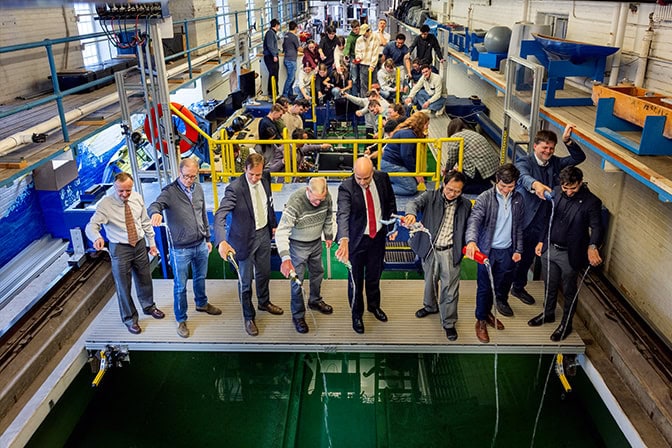
That’s why, on Feb. 24, 2026, Senator Gary Peters’s Office joined U-M faculty, students and staff in a traditional “mixing of the water”—a ceremonial pouring of water (and, perhaps, knowledge) from from 41 tow tanks in 19 countries into U-M’s newly-reopened Richard B. Couch Model Basin. These days, the water is mostly mailed in ahead of time, though visitors from Germany’s Hamburg Ship Model Basin, Sweden’s Kongsberg Hydrodynamic Research Center joined the festivities.
The event capped off months of renovations at the 750,000-gallon, 360-foot-long facility, which is the crown jewel of the Aaron Friedman Marine Hydrodynamics Laboratory. The basin was the first of its kind to be installed at an American university and is still the largest. Over its 120-year history, it has helped launch some of the most significant innovations in naval architecture, including the fuel-saving “bulbous bow” technology that’s used on nearly all of the large cargo ships that transport 90% of the world’s goods.
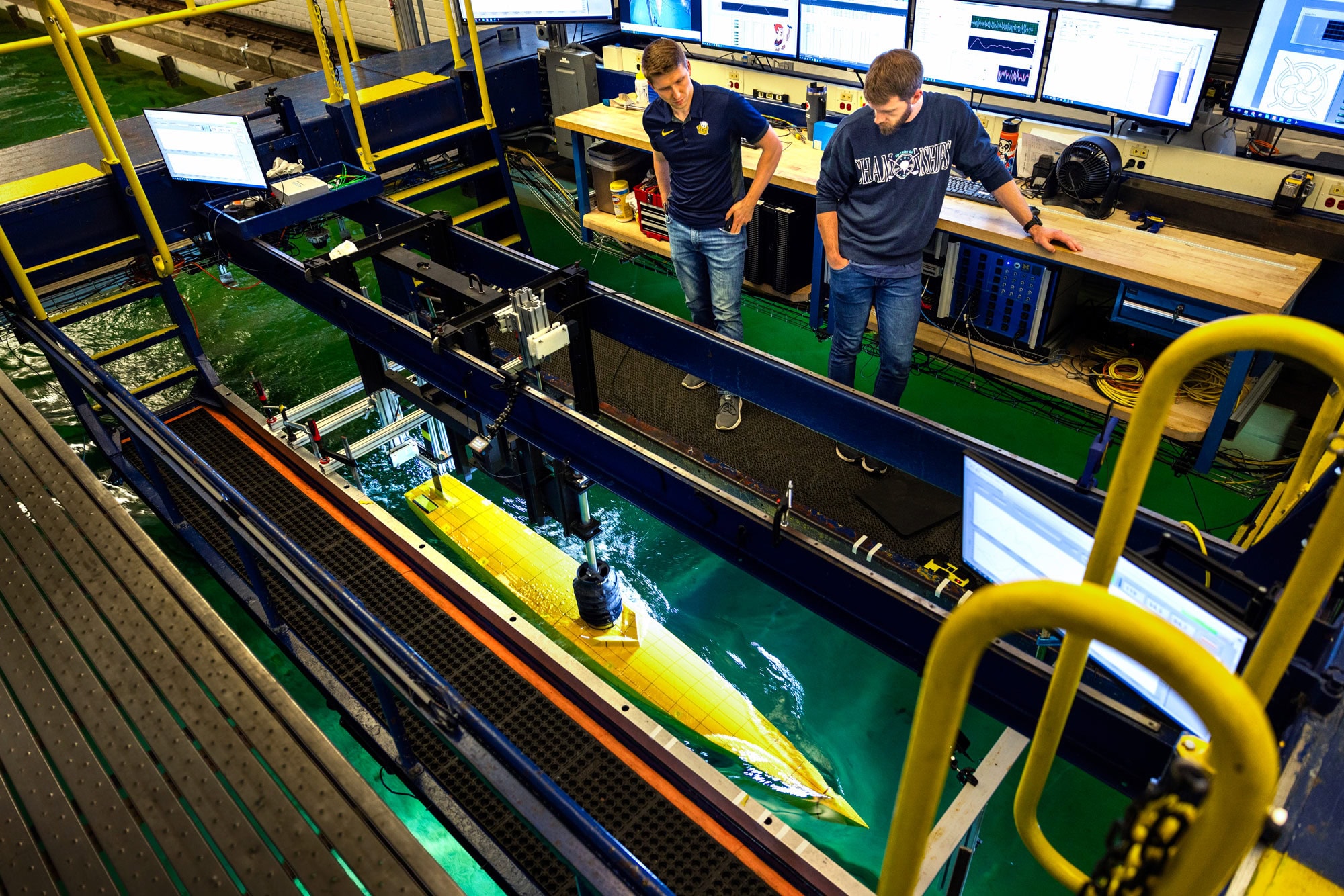
Jason Bundoff, lead engineer in research (left), and Zachary Campeau, lead electrical engineer, test the performance of a model low-profile vessel in the Richard B. Couch Model Basin.
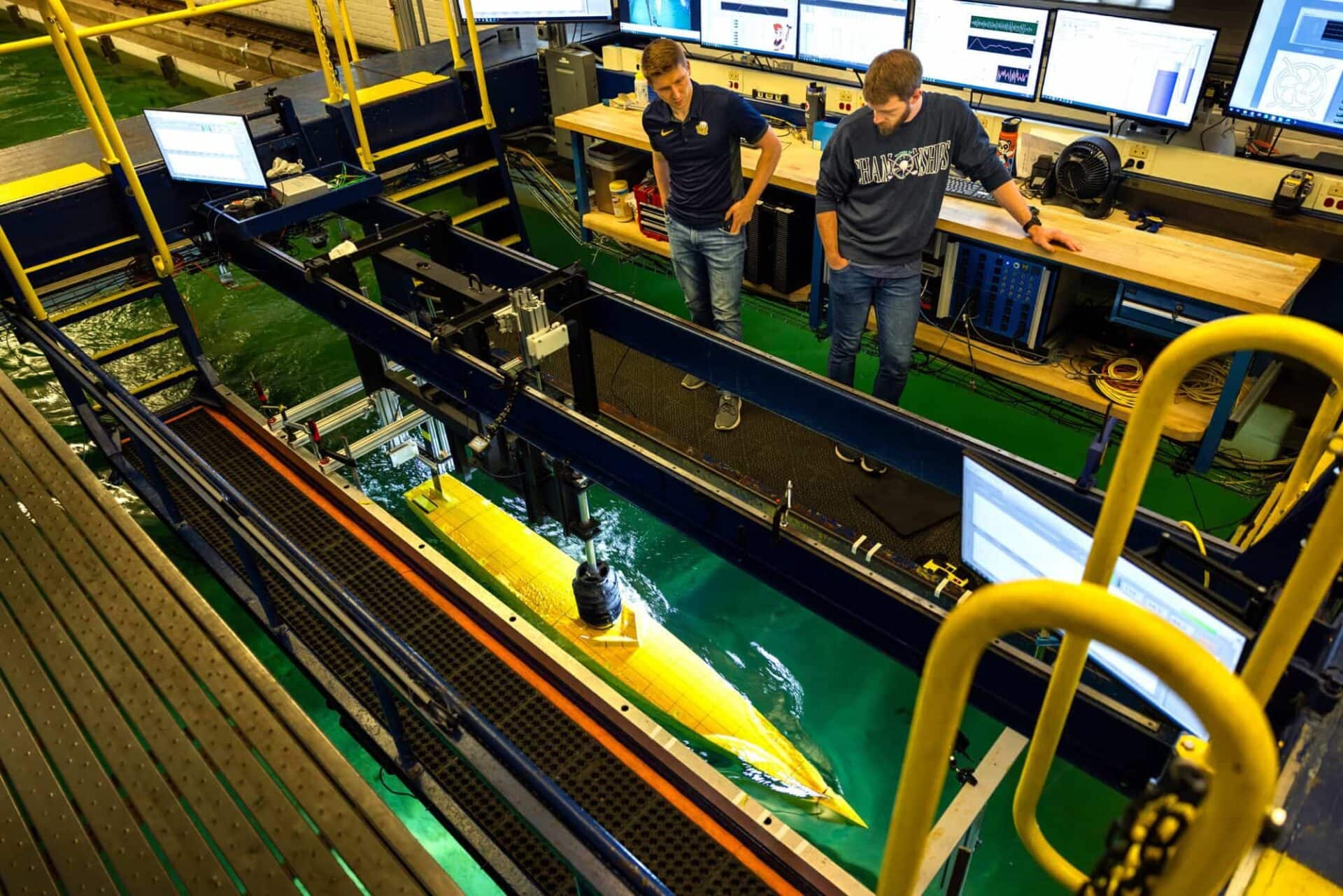
Jason Bundoff, lead engineer in research (second left), and Zachary Campeau, lead electrical engineer (first left), review the data collected during their tests of a model low-profile vessel. Jim Smith, a research project engineer, reviews data in the back.
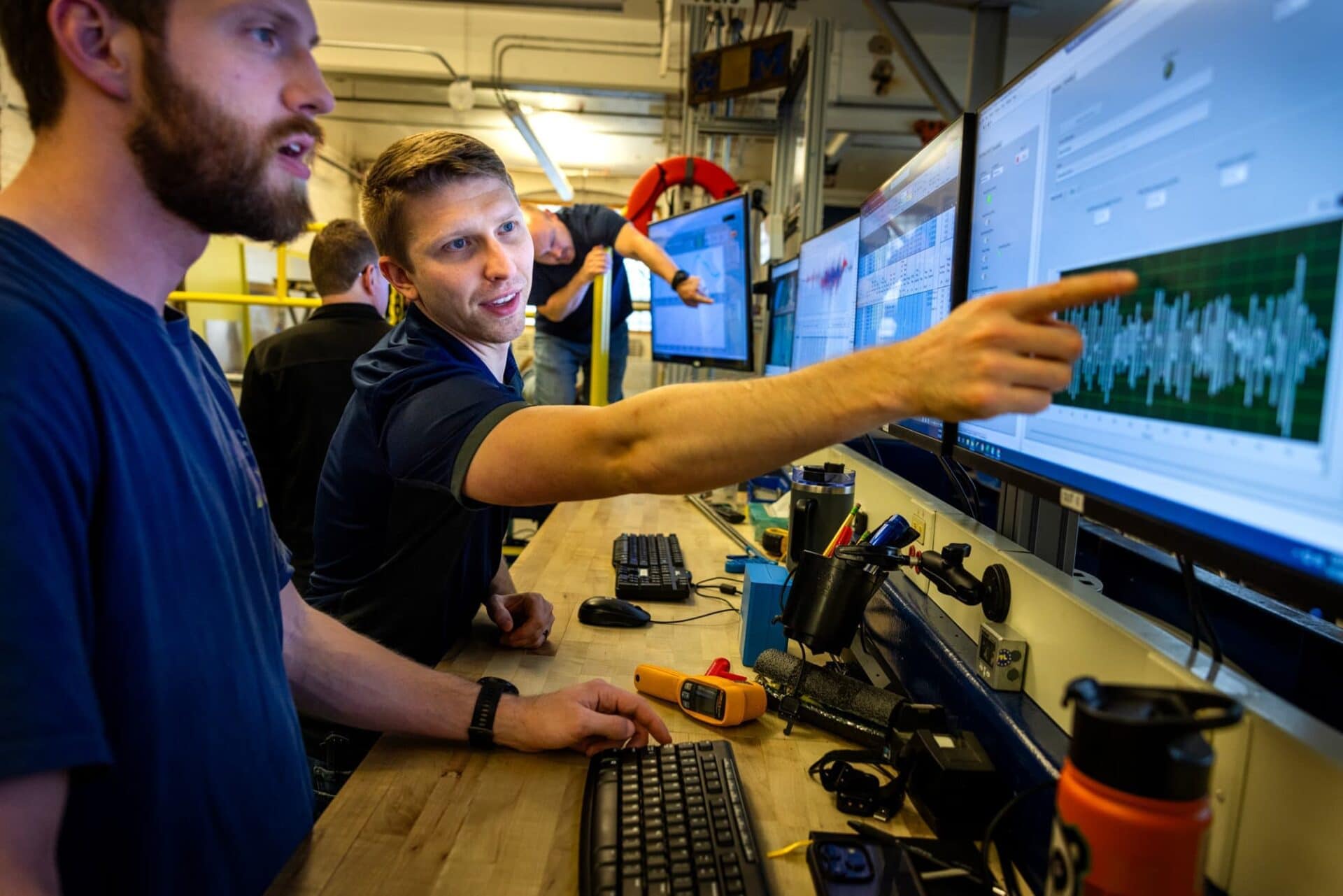
There’s no such thing as an average day at the facility. It’s referred to as the “tow tank” because engineers often use a motorized platform to drive model ships down the length of the tank, which helps test a vessel’s seaworthiness. On other days, a prototype wave energy converter might rock to the steady rhythm of waves, not to mention the numerous tests performed for external clients across the shipping, defense and marine energy industries.
“That we have so many participants at today’s ceremony is testimony to the fact that physical tanks, and the people that run them, are still critical in society and engineering although we share more and more of our workload with computer simulations,” said Kevin Maki, the director of U-M’s Aaron Friedman Marine Hydrodynamics Laboratory and a professor of naval architecture and marine engineering. “There’s a fellowship among the tanks that we want to celebrate.”
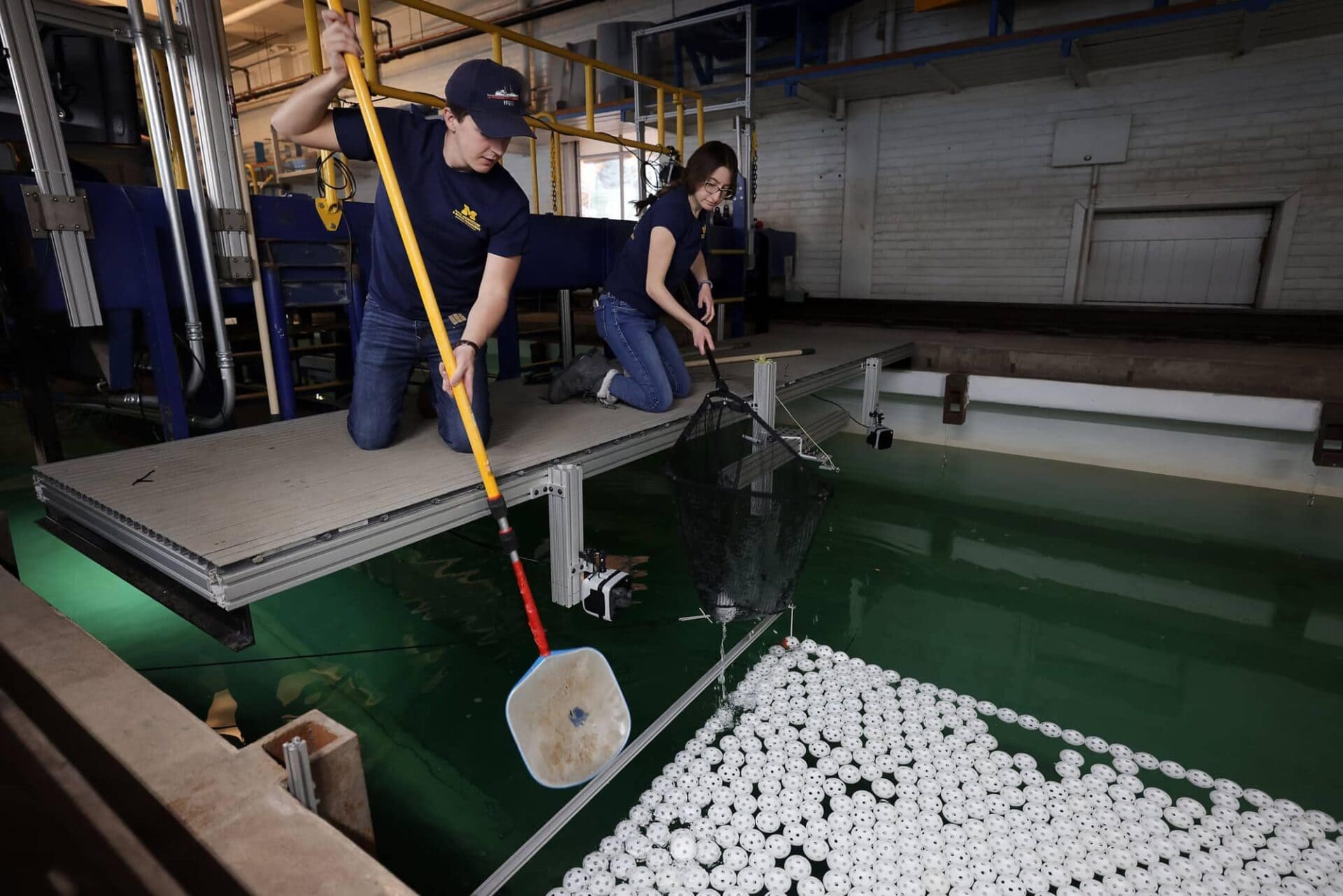
Jackson Brown and Adina Farca, both graduates of U-M naval architecture and marine engineering, corral wiffle balls into a confined area in the Richard B. Couch Model Basin. The wiffle balls simulate sea ice for their undergraduate research project. Photo by Brenda Ahearn, University of Michigan Engineering.
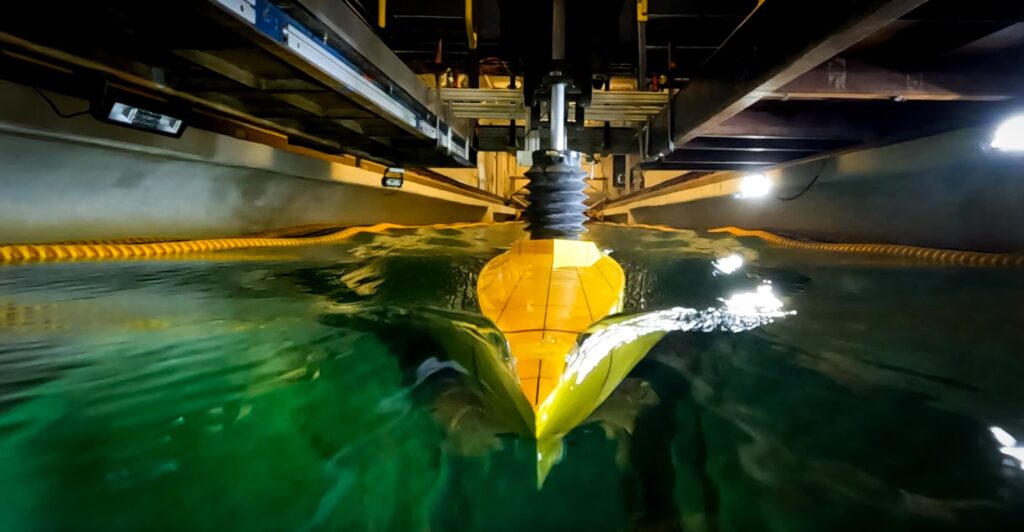
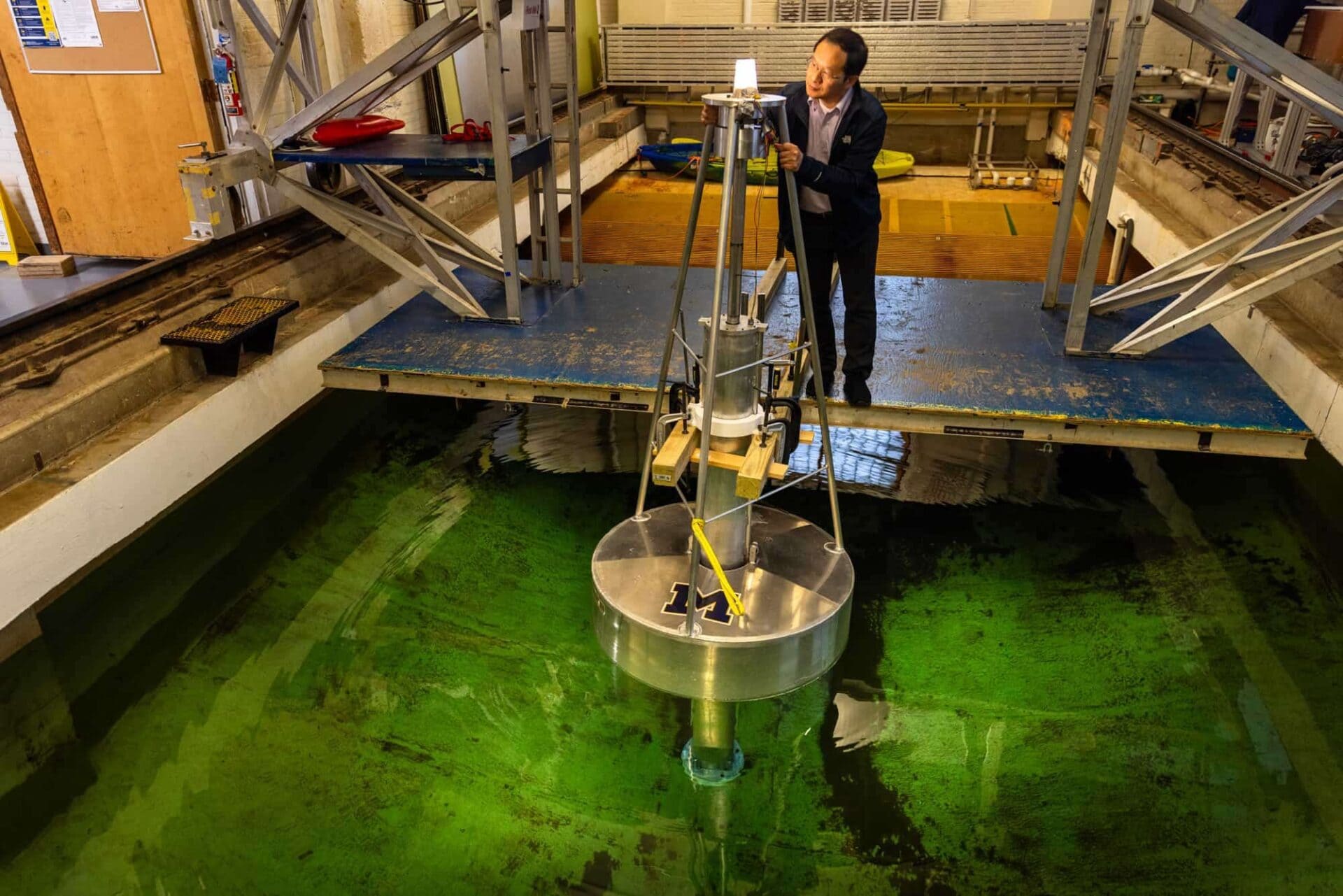
Lei Zuo, the Herbet C. Sadler Collegiate Professor of Engineering, tests a wave energy converter in the tow tank. A bulb at the top of the device lights up as it bobs with waves.
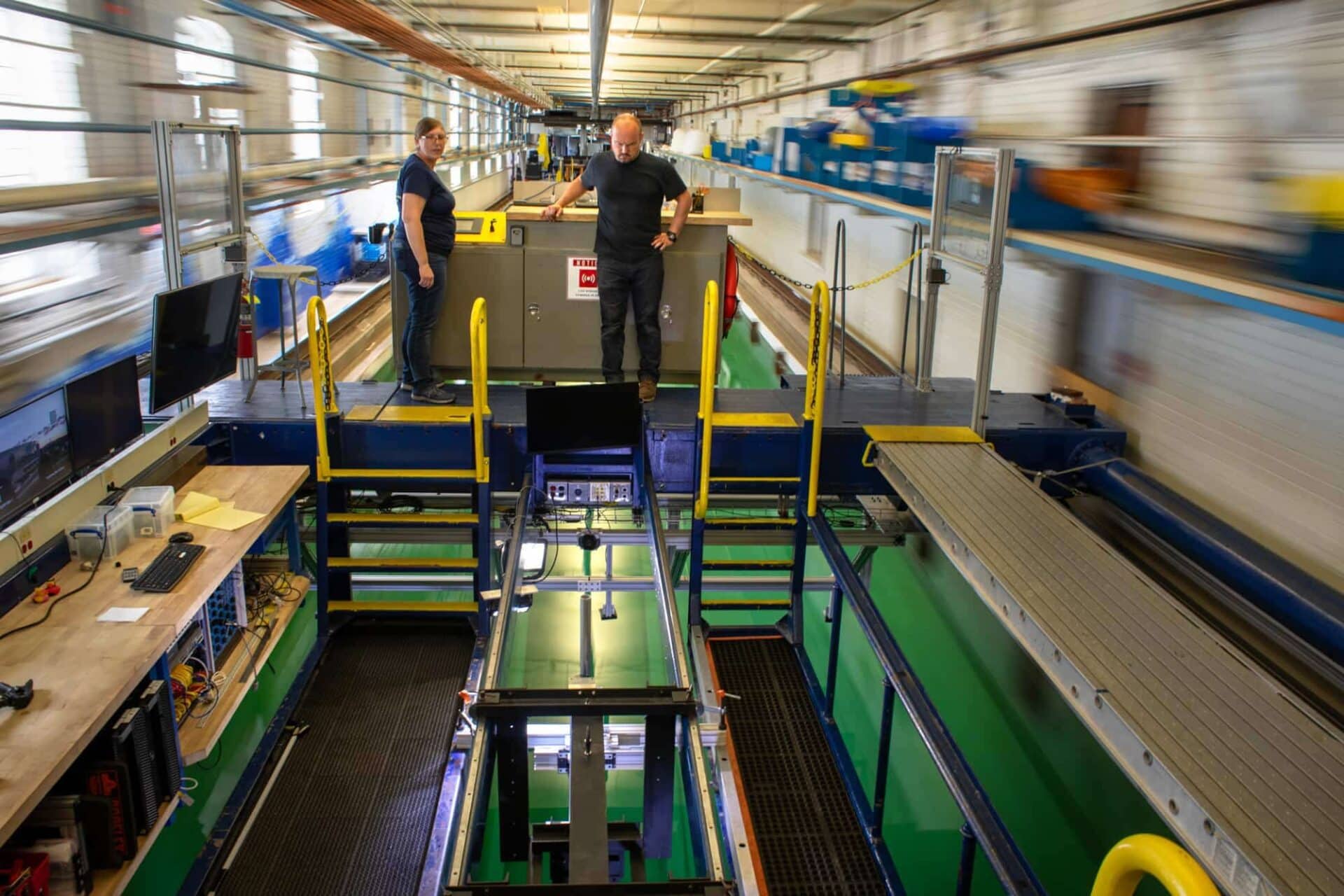
Nicole Cheesman, Administrative Specialist (left), and Jim Smith, Research Project Engineer (right), test the moving platform at the MHL tow tank.
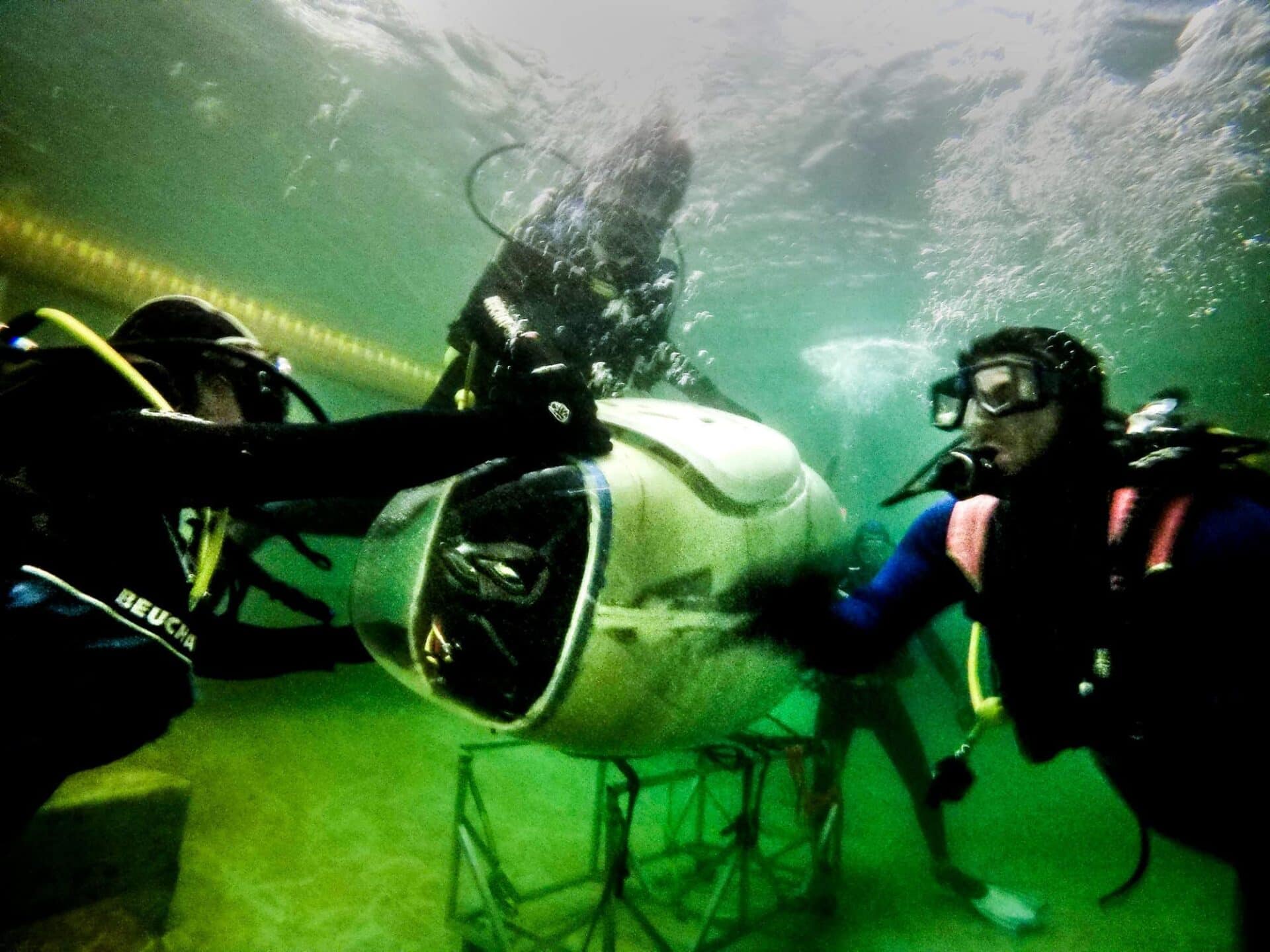
Members of Michigan’s human-powered submarine team practice underwater navigation in the tow tank. Photo by Joseph Xu, Michigan Engineering.
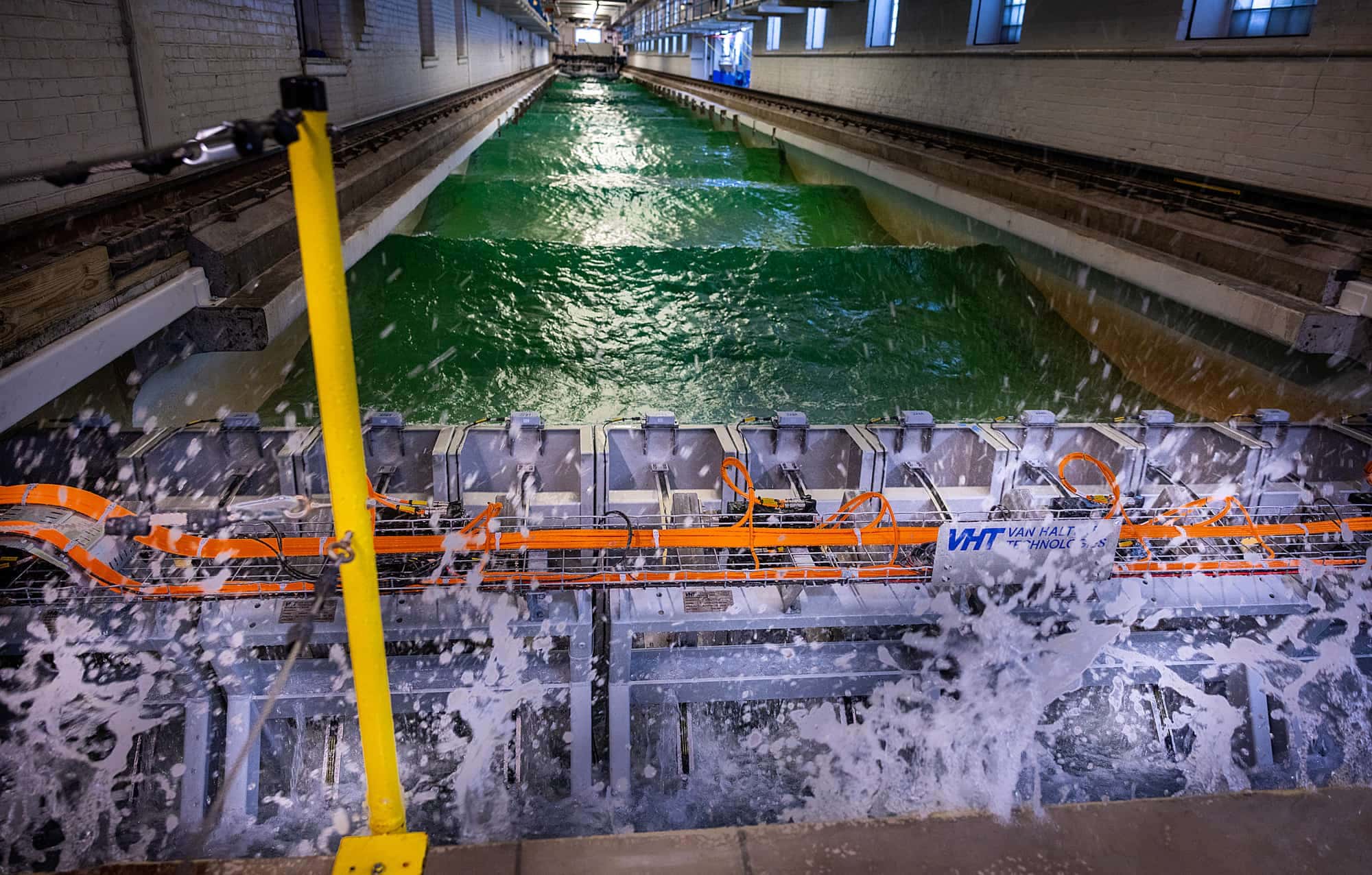
The lab is re-opening with a new wave-making system, which uses 24 independently moving paddles to make waves up to nearly two feet high that can hit a model ship from several directions. It’s a major upgrade to the previous system, which could only generate head-on waves of uniform height that could only swell to half the size. The new technology will enable engineers to more accurately evaluate the performance of their prototypes in stormy seas.
The wave makers are just the latest in a series of improvements over the past two years. In 2024, for example, the tank’s carriage received a new control system and motors that enable finer speed controls and a wider variety of maneuvers that more closely resemble the movements of real ships. The new tools will help Michigan Engineers continue the tradition of scientific progress honored during the facility’s re-opening ceremony.
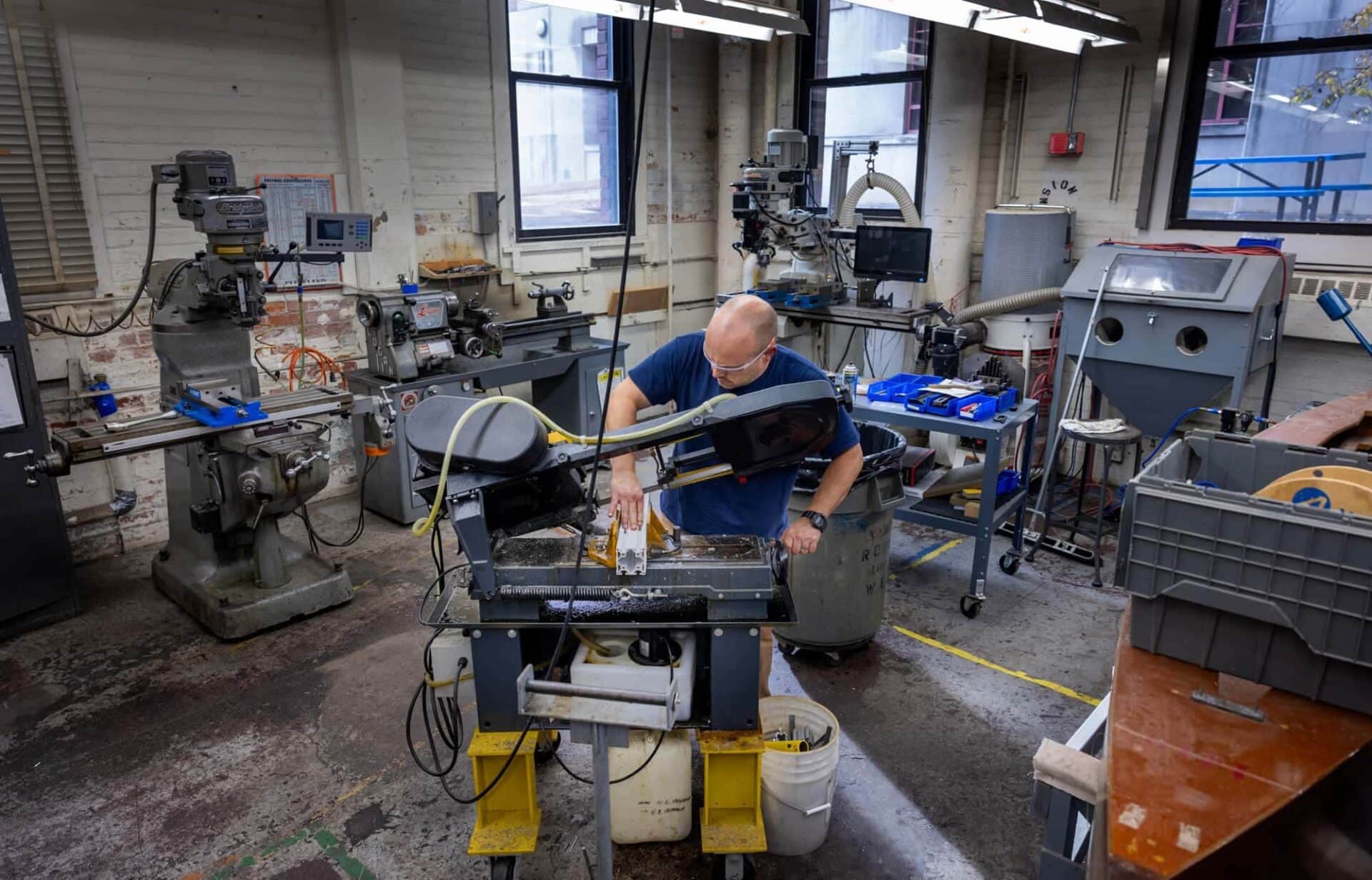
Jim Smith, research project engineer at the Marine Hydrodynamics Lab, operates a large metal milling machine in the lab’s workshop.
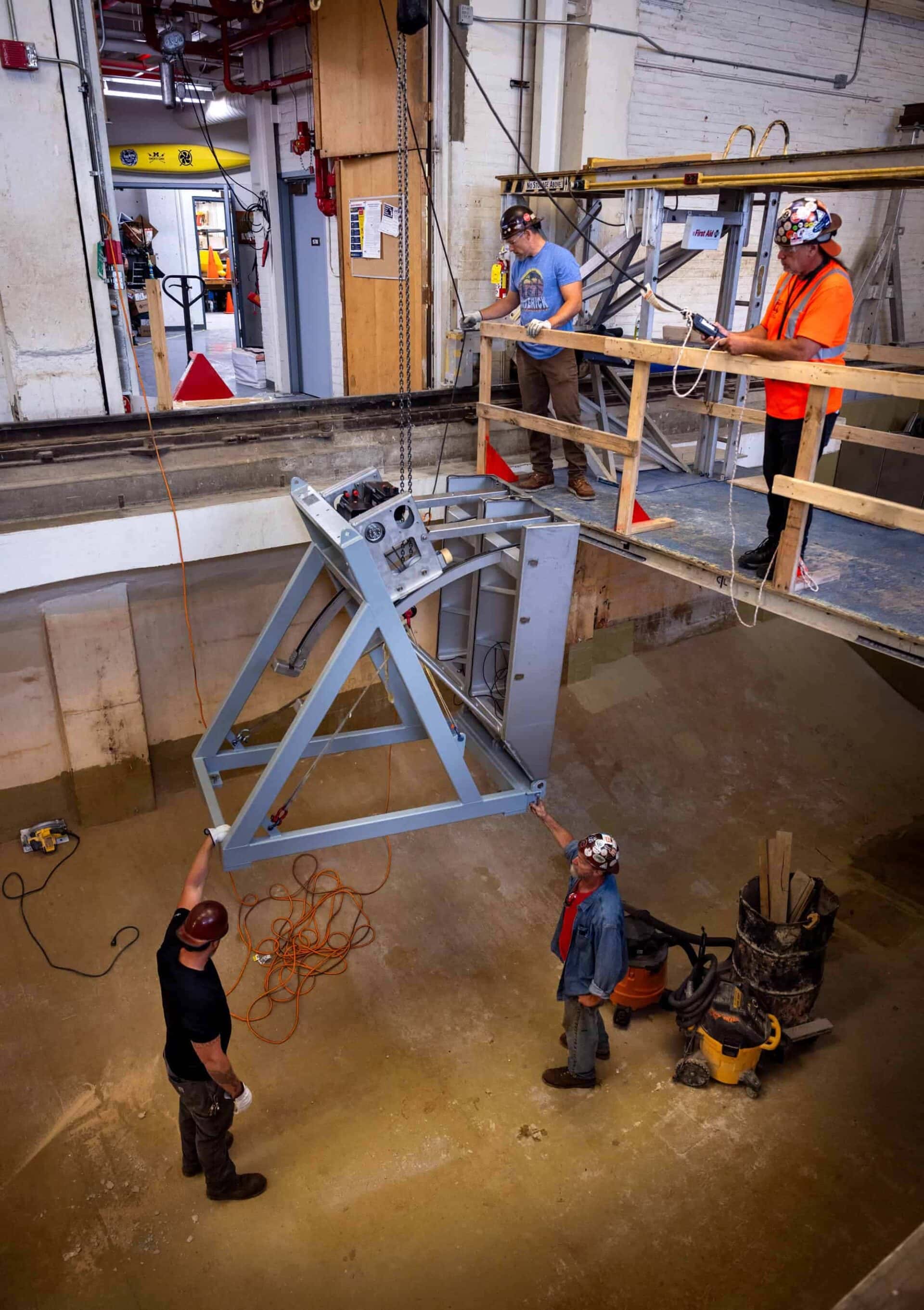
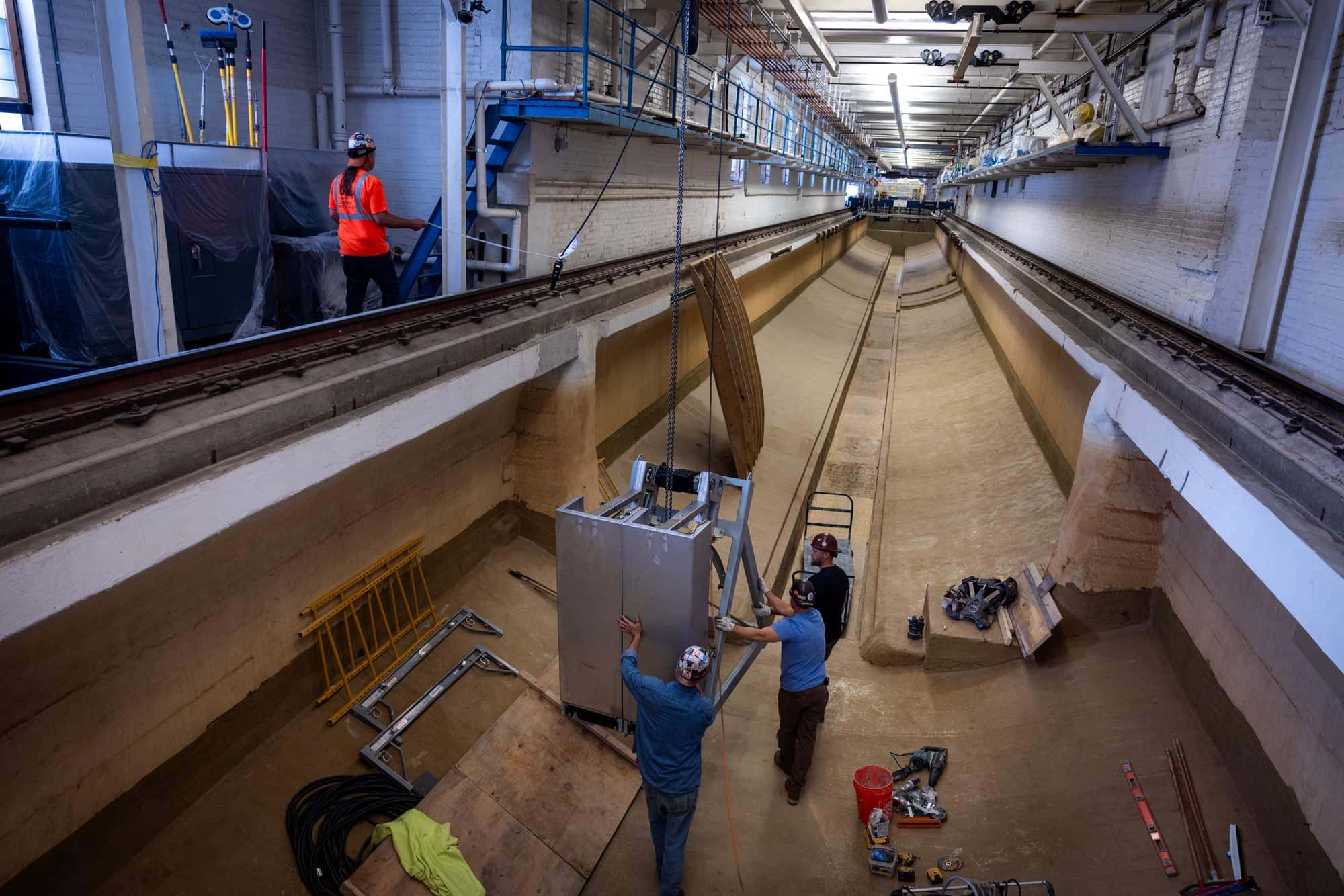
A team of contractors lower a new wave-maker into the tow tank, which has been drained for the renovations.
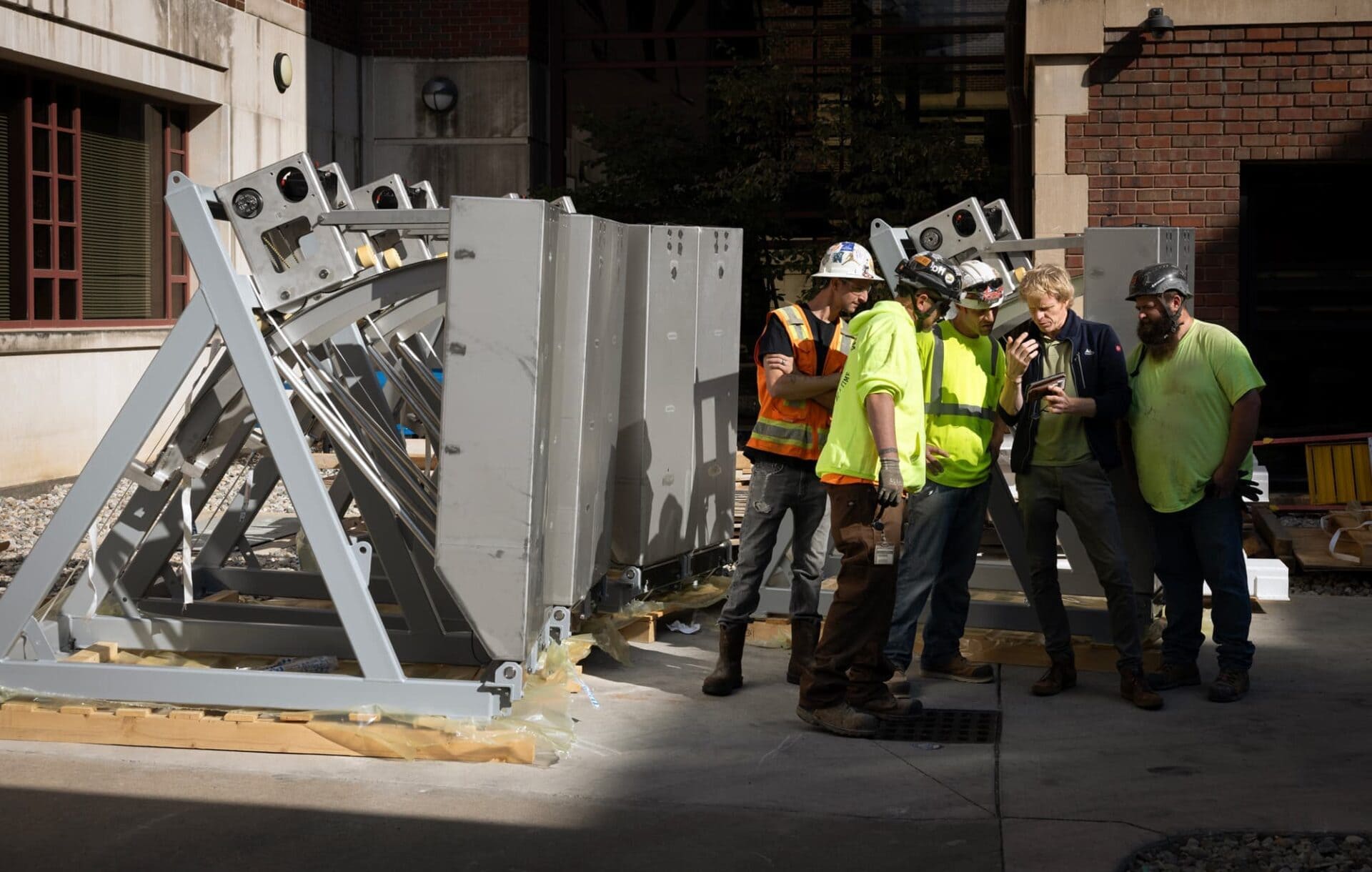
Marcel Koeleman from VHT, the wave maker’s manufacturer, shows a team of contractors the installation plans for the new wave-making system. A few panels from the system are placed nearby.
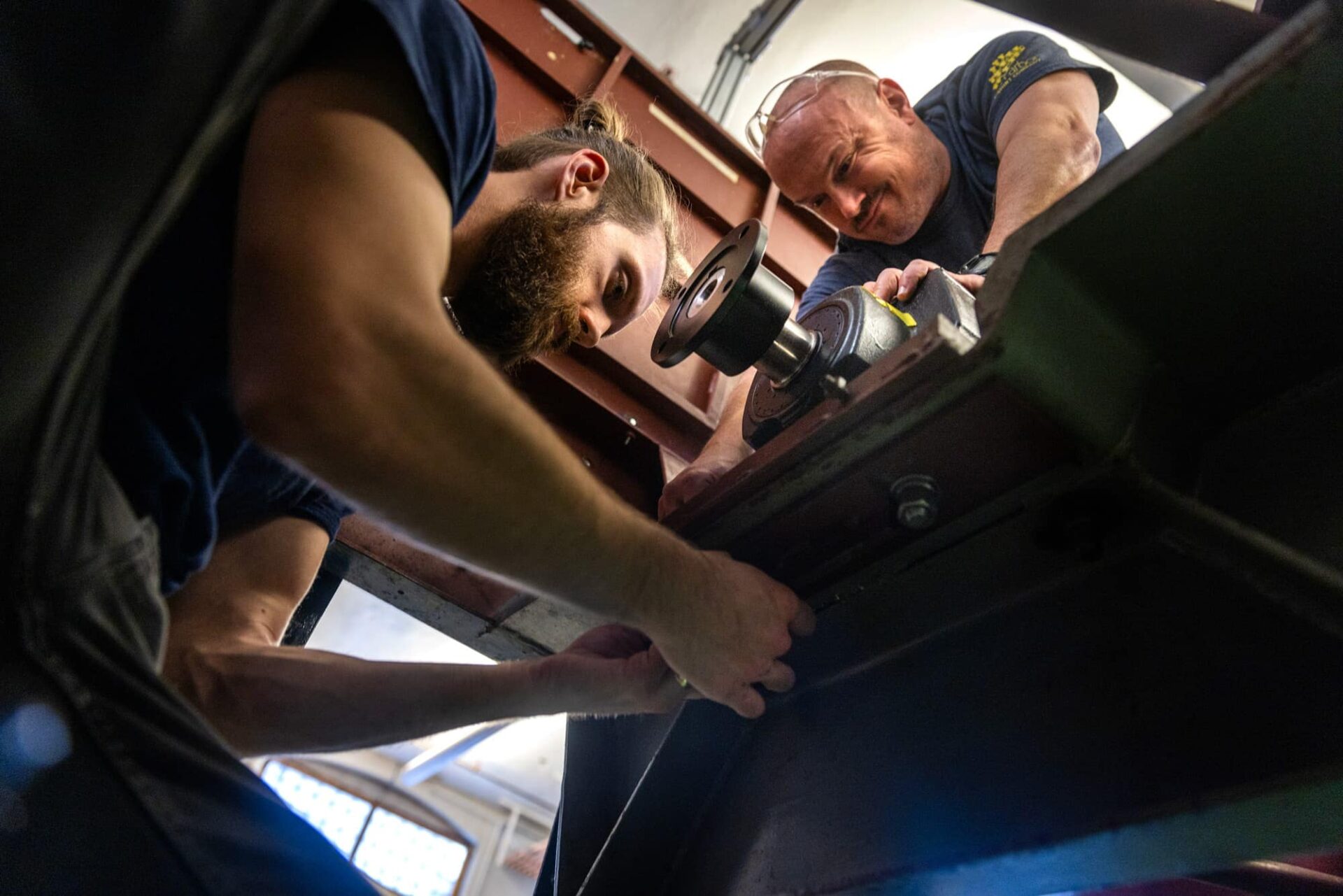
Jim Smith, research project engineer (right), and Zach Campeau, lead electrical engineer (left), install new motors, gear boxes, and brakes onto the tow tank’s motorized platform, called the carriage.
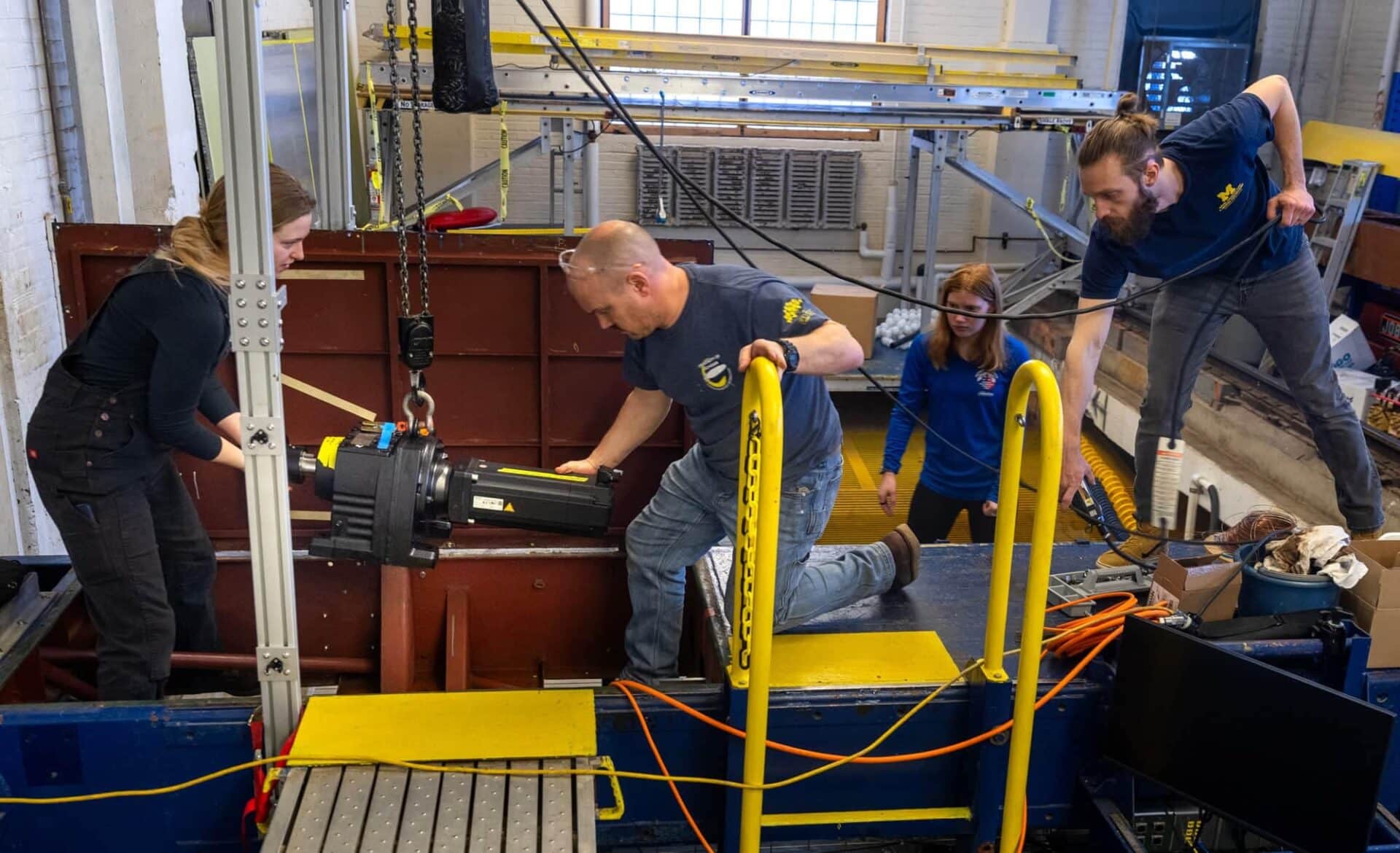
Staff from the Aaron Friedman Marine Hydrodynamic Lab’s install the carriage’s new motors. They are, from left to right, Anika Lorant, former Associate Director, Jim Smith, research project engineer, Arianna Kerkmaz, a U-M graduate in naval architecture and marine engineering, and Zach Campeau, lead electrical engineer.
Some of the water mixed into the U-M tank dates back to the first-ever towing tank, built by William Froude in Torquay, England, in 1872. With the tank, Froude developed equations that he used to scale the amount of resistance felt by a model ship to a full-size vessel and describe the forces created by early propellers. Froude’s equations are still used by naval architects to predict a vessel’s performance using a scale model.
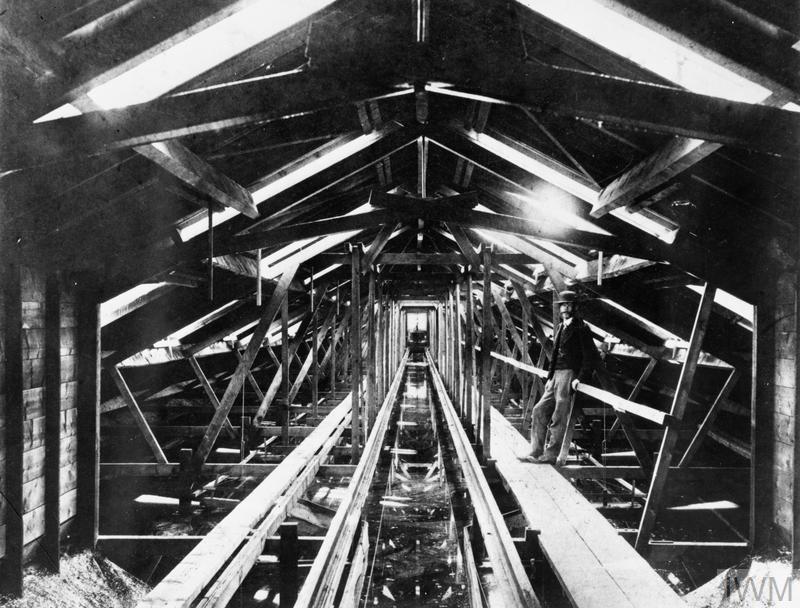
Froude’s son, Robert, followed his father’s example by building the world’s third tow tank in Haslar, England, in 1886, seven years after his father passed away. Robert Froude added water from the first tank into the new tank to commemorate his father, and the field has carried on the tradition ever since. Although the original Haslar Tank has since closed, QinetiQ (pronounced “kinetic”), the defense companythat manages the tanks at the Haslar lab, keeps water from the original tank for opening ceremonies.
“It’s a nice, tangible link back to William Froude and his son,” said Chris Richardsen, a principal consultant of engineering and operations at QinetiQ and the company’s unofficial historian. “Maybe a bit of that magic went into the new facility.”
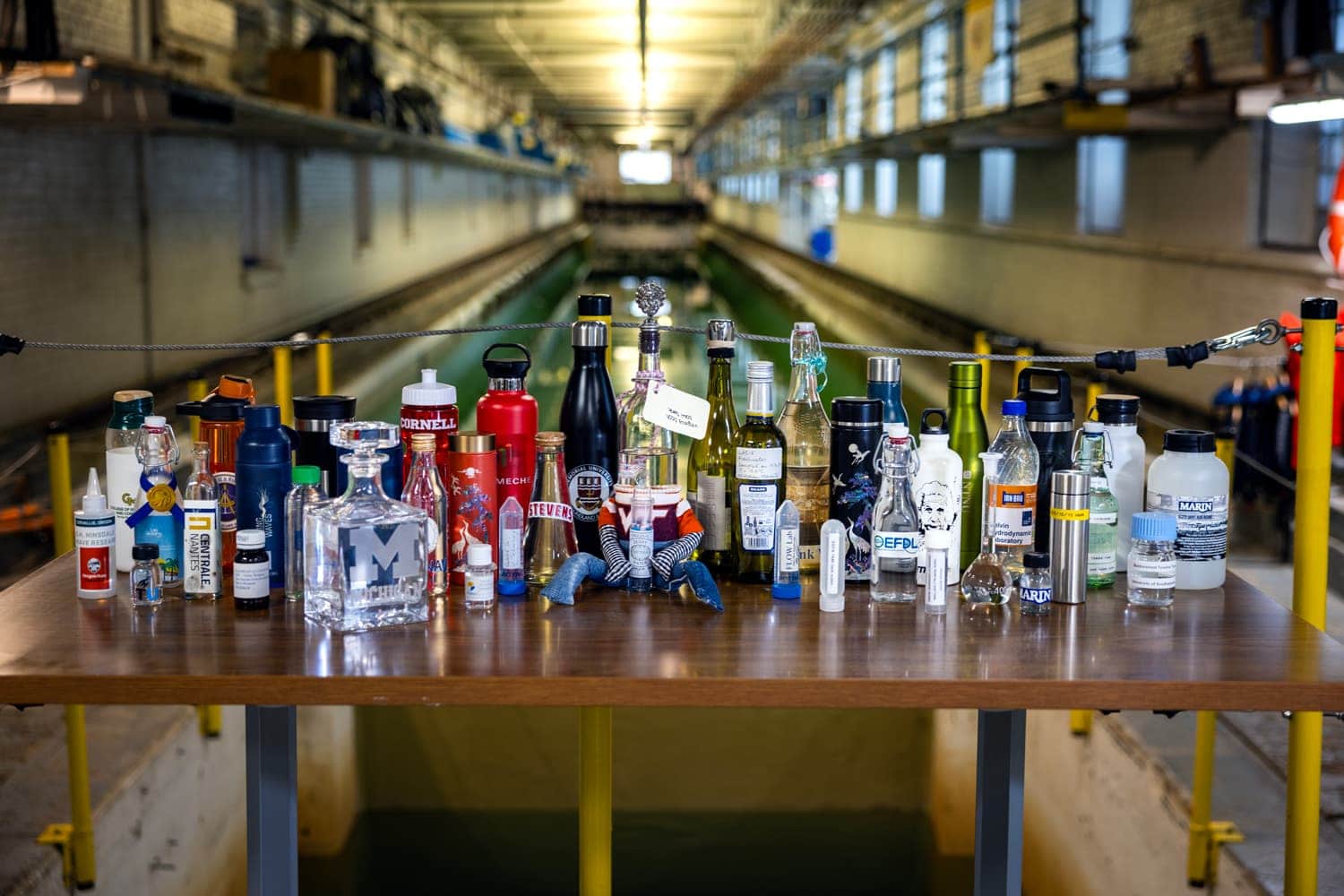
Locations of each donor of the Mixing of the Waters Ceremony for 2025. View full-screen version of the map on Google Maps.
For some, the “magic” is in Froude’s formulas, which have also enabled the breakthroughs of other world-class facilities that sent water to U-M. For others, the magic is felt in the experience working on the tow tank.
“When people step onto the carriage for the first time, you can really feel their energy and excitement as they start to see the spray of water and feel the carriage move,” said Jim Smith, a research project engineer at the Aaron Friedman Marine Hydrodynamics Laboratory. “It’s a really rich piece of U-M history.”